Have you ever seen “A/S/L?” in an old chat, social media post, or online conversation and wondered what those three letters actually mean?
You are not alone. A/S/L is one of the classic internet abbreviations from the early days of online chatting. Although it is less common today, you may still encounter it in conversations about internet culture, gaming, forums, or casual messaging.
So, what does A/S/L meaning actually refer to?
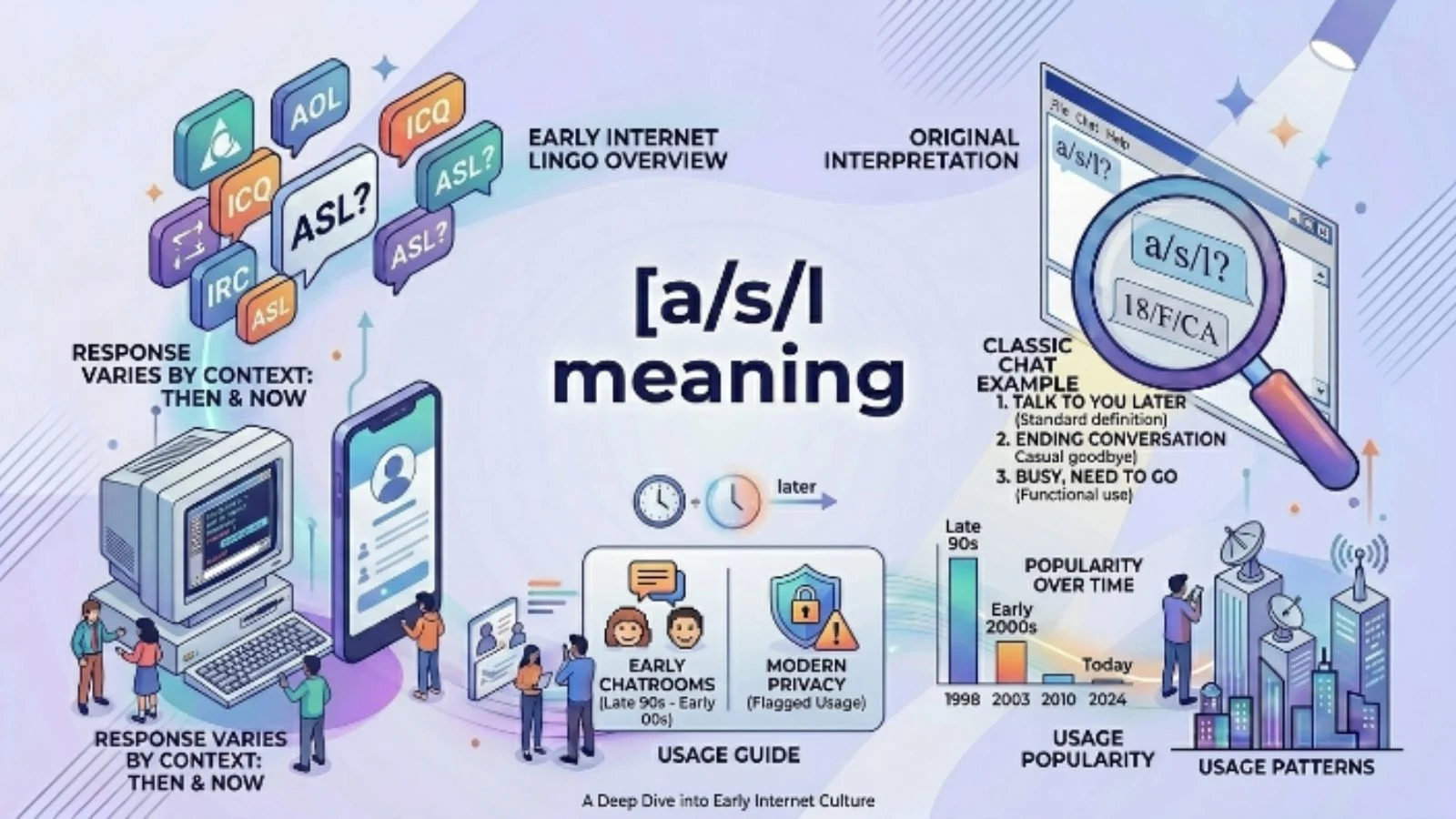
In simple terms, A/S/L stands for “Age/Sex/Location.” It was traditionally used online to quickly ask someone how old they were, what their sex was, and where they were located.
But there is more to this abbreviation than its basic definition. The meaning, tone, and appropriateness of A/S/L can depend heavily on the situation.
What Does A/S/L Mean?
A/S/L means “Age/Sex/Location.”
It was commonly used in early internet chat rooms and instant messaging services as a quick way to ask another person:
- A = Age: How old are you?
- S = Sex: Are you male or female?
- L = Location: Where are you from or where do you live?
For example, someone might type:
“A/S/L?”
The other person might respond:
“22/F/Chicago.”
This means the person is saying they are 22 years old, female, and located in Chicago.
Today, the abbreviation can sound old-fashioned because modern social media conversations usually use more natural questions such as “How old are you?”, “Where are you from?”, or “What’s your age?”
A/S/L Meaning in Simple Words
The easiest way to understand A/S/L is:
A/S/L is an old internet shorthand for asking someone’s age, sex, and location.
It was designed to save time when chatting online.
Instead of typing:
“How old are you, what is your sex, and where are you from?”
a person could simply type:
“A/S/L?”
This made conversations faster, especially when people were communicating through text-only chat rooms.
Where Did A/S/L Come From?
A/S/L became popular during the early era of internet chat rooms and instant messaging.
Before modern social networks became dominant, people often met strangers through online chat rooms. Users might know very little about one another, so basic personal information was often exchanged at the beginning of a conversation.
Typing A/S/L? became a quick way to start that process.
It was particularly associated with the culture of early online chatting and anonymous conversations.
The abbreviation became so recognizable that it eventually became part of internet slang history.
Today, you are more likely to see A/S/L when someone is:
- Talking about early internet culture
- Discussing old chat rooms
- Sharing nostalgic online experiences
- Quoting older internet conversations
- Making a joke about outdated internet slang
- Using it ironically
Why Did People Use A/S/L?
There were several reasons people used A/S/L.
1. It Saved Time
Early online conversations were often fast-paced. Short abbreviations allowed people to communicate quickly.
Instead of asking three separate questions, users could simply type A/S/L?
2. It Helped People Get Basic Information
When chatting with a stranger, age and location could help establish some context.
For example, knowing someone’s approximate age could influence the topics being discussed.
3. It Was Common Chatroom Language
A/S/L became part of the informal language used in online communities.
Just as people today use abbreviations such as LOL, BRB, or IDK, earlier internet users had their own shorthand.
4. It Reflected Anonymous Internet Culture
Early chat rooms often allowed people to communicate without revealing their real identities.
Asking A/S/L was one way to learn basic information while maintaining a certain level of anonymity.
A/S/L Examples in Real Conversations
Understanding A/S/L becomes easier when you see how it works in context.
Example 1: Classic Chat
Person 1: Hey, what’s up?
Person 2: Not much. A/S/L?
Person 1: 21/F/Texas.
Here, Person 2 is asking for the other person’s age, sex, and location.
Example 2: Old-School Internet Conversation
Person 1: Hi! A/S/L?
Person 2: 25/M/Canada.
This is a typical example of how the abbreviation was historically used.
Example 3: Talking About Internet History
Person 1: People used to ask “A/S/L?” all the time in chat rooms.
Person 2: Seriously? That’s definitely old-school internet slang.
In this case, A/S/L is being discussed rather than used as a personal question.
Example 4: Using It as a Joke
Friend 1: We need to settle something important.
Friend 2: What?
Friend 1: A/S/L?
Here, the person may be deliberately using outdated internet slang for humor.
Is A/S/L Still Used Today?
A/S/L is much less common today than it was during the early days of online chatting.
Modern platforms have changed how people introduce themselves.
On social media, users may already have profiles showing information such as:
- Age or birth year
- City or country
- Gender identity
- Interests
- Photos
- School or workplace
Because of this, people generally do not need a three-letter abbreviation to ask for basic information.
Still, A/S/L has not completely disappeared.
You might encounter it in discussions about old-school internet culture, retro chatrooms, online role-playing communities, or humorous conversations.
A/S/L vs. Similar Internet Slang
A/S/L is sometimes confused with other short internet expressions, but these abbreviations do not mean the same thing.
| Slang | Meaning | Main Purpose |
|---|---|---|
| A/S/L | Age/Sex/Location | Asking basic personal information |
| ASL | American Sign Language | Refers to a language |
| HMU | Hit Me Up | Asking someone to contact you |
| WYA | Where You At? | Asking someone’s current location |
| HBU | How About You? | Returning a question |
| WYLL | What You Look Like? | Asking what someone looks like |
| IDK | I Don’t Know | Expressing uncertainty |
One important point is that ASL without the slashes can have a completely different meaning.
For example, ASL can refer to American Sign Language.
Therefore, context matters.
A/S/L vs. ASL
The slash marks can help provide context.
A/S/L traditionally means:
Age / Sex / Location
But ASL can mean:
American Sign Language
For example:
“Do you know ASL?”
This usually refers to American Sign Language.
Meanwhile:
“A/S/L?”
in an old chat context traditionally means Age/Sex/Location.
So, don’t automatically assume that every use of ASL refers to the internet abbreviation.
When Should You Use A/S/L?
If you are wondering whether you should actually use A/S/L in a conversation today, the answer is: use it carefully.
It is generally better to ask personal questions naturally.
Instead of:
“A/S/L?”
you could say:
“Where are you from?”
or:
“If you don’t mind me asking, how old are you?”
These questions usually sound more natural and respectful.
A/S/L can work when you are:
- Making a joke about old internet culture
- Talking about historical chatrooms
- Writing dialogue for an old-school internet setting
- Communicating with someone who understands the slang
- Discussing internet slang itself
Is A/S/L Appropriate to Ask Strangers?
This is where some caution is useful.
Age and location can be personal information.
Someone may not want to share their age or where they live, particularly when talking to a stranger online.
Instead of immediately asking for all three pieces of information, consider allowing the other person to share what they are comfortable sharing.
For example:
“Where are you from, if you’re comfortable sharing?”
This gives the other person more control over the conversation.
You should also avoid sharing sensitive information such as your exact home address, phone number, passwords, financial information, or other private details with strangers online.
Common Misunderstandings About A/S/L
Misunderstanding 1: A/S/L Is a Modern Snapchat Term
Not exactly.
A/S/L is primarily associated with older internet chat culture. It predates today’s major social media platforms.
Misunderstanding 2: A/S/L Always Means American Sign Language
No.
A/S/L in an old chat context usually means Age/Sex/Location.
However, ASL can also mean American Sign Language, so context is important.
Misunderstanding 3: Everyone Should Answer A/S/L
Definitely not.
You never have to share personal information simply because someone asks.
You can ignore the question, give a general answer, or politely say that you would rather not share.
Misunderstanding 4: A/S/L Is Completely Meaningless Today
Not necessarily.
While it is less common, people still use it for nostalgia, humor, internet-history discussions, and references to early online chat culture.
A/S/L on Social Media
You may occasionally encounter A/S/L on modern social platforms.
Its appearance can have different purposes.
Someone might use it seriously, especially in communities where users are meeting strangers.
Another person might use it sarcastically because the expression sounds like classic early-internet slang.
For example:
“A/S/L? Haven’t heard that since the old chatroom days.”
Here, the phrase is being used to reference internet history rather than genuinely request someone’s personal details.
A/S/L in Gaming and Online Communities
Gaming communities have also preserved many older internet abbreviations.
You could see A/S/L used jokingly when players are talking about the history of online gaming or old chatroom culture.
However, it is not generally necessary in modern gaming conversations.
Players are more likely to ask direct questions such as:
“Where are you from?”
or:
“How old are you?”
The exact meaning still depends on context.
Pro Tips for Understanding A/S/L
If someone sends you “A/S/L?”, keep these points in mind:
- A/S/L traditionally means Age/Sex/Location.
- It is strongly associated with old-school internet chat.
- The abbreviation may be used humorously today.
- ASL can also mean American Sign Language.
- You do not have to answer personal questions from strangers.
- Never share sensitive personal information just because someone asks.
- Look at the surrounding conversation before deciding what the abbreviation means.
How to Respond to A/S/L
Your response depends on how comfortable you are.
If You Want to Answer
You can provide general information:
“I’m 24 and from Pakistan.”
You do not need to provide more information than you are comfortable sharing.
If You Don’t Want to Answer
You can simply say:
“I’d rather not share that.”
Or:
“I usually don’t give out personal information online.”
If Someone Uses It as a Joke
You can respond playfully:
“Wow, that’s some serious old-school internet slang.”
The best response depends on the tone of the conversation.
Why A/S/L Still Matters
Although A/S/L may look outdated, it represents an interesting part of internet history.
Today’s online communication is filled with abbreviations, memes, GIFs, emojis, and platform-specific slang.
A/S/L reminds us that people were already developing shortcuts for online communication decades ago.
The technology has changed, but the basic idea remains familiar: people want to quickly understand who they are talking to.
Final Thoughts
A/S/L means “Age/Sex/Location,” and it is one of the classic abbreviations associated with early internet chat culture. It was once a common way for people to ask strangers for basic personal information quickly.
Today, you are less likely to see it used seriously. Instead, A/S/L often appears when people are discussing old internet culture or using the expression humorously.
If you see “A/S/L?” in a conversation, remember that context matters. It usually refers to age, sex, and location, but ASL can also mean American Sign Language.
And if someone asks you for personal information online, remember that you are never required to share anything you would rather keep private.
Frequently Asked Questions
What does A/S/L mean in texting?
A/S/L means “Age/Sex/Location.” It is an old internet abbreviation traditionally used to ask someone’s age, sex, and location.
Is A/S/L still used today?
Yes, but it is much less common than it was during the early days of internet chatrooms. Today, it is often used nostalgically, humorously, or when discussing internet history.
What does ASL mean without the slashes?
ASL can mean several things depending on context. One common meaning is American Sign Language. In older online chat, however, ASL could refer to the same “Age/Sex/Location” abbreviation.
Is it safe to answer A/S/L online?
You should use your judgment. You are not required to share your age, location, or other personal information with strangers. Avoid revealing sensitive details such as your exact address or other private information.