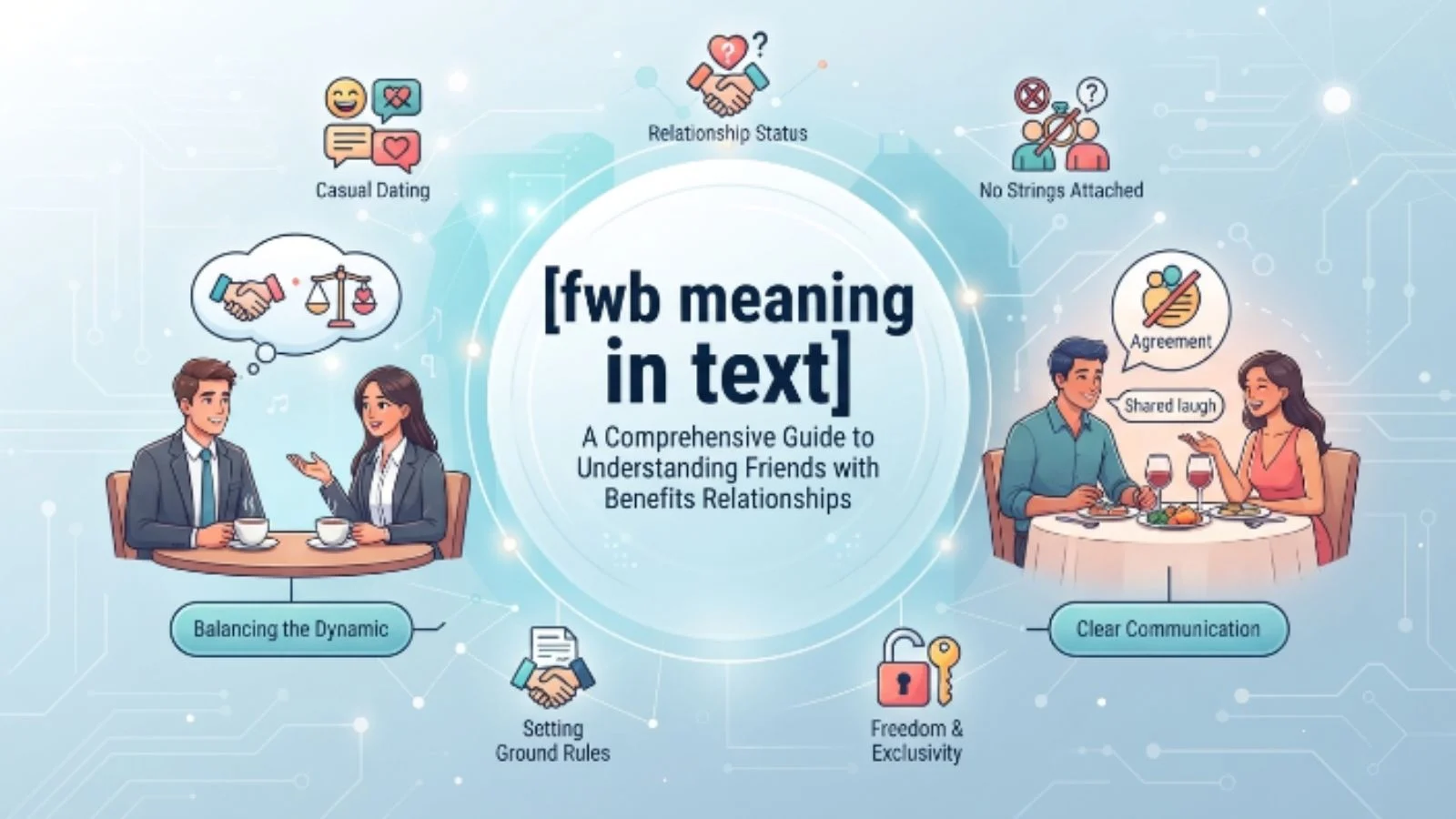
You are chatting with someone when they suddenly say, “I’m only looking for an FWB.”
If you are not familiar with internet slang, you might wonder what they mean. Is it a friendship? A relationship? Or something completely different?
The truth is, FWB is one of the most common abbreviations used in texting, dating apps, and social media. However, many people misunderstand its meaning, which can lead to confusion and awkward conversations.
In this guide, you’ll learn exactly what FWB meaning in text is, where it’s used, when you should use it, and how it differs from other relationship terms.
What Does FWB Mean in Text?
FWB Meaning in Text (Quick Answer)
FWB stands for Friends With Benefits.
It describes two people who are friends and also have a physical or sexual relationship without being in a committed romantic relationship.
Unlike dating, an FWB arrangement usually does not include expectations of exclusivity, long-term commitment, or becoming boyfriend and girlfriend.
Featured Definition
FWB means “Friends With Benefits.” In texting and online conversations, it refers to two friends who share a physical relationship without being in a committed romantic relationship.
Simple Meaning of FWB
In simple words, FWB means:
Two friends who enjoy spending time together and also have a physical relationship, but they are not officially dating.
The key word here is friends.
People in an FWB situation often continue their normal friendship while agreeing that their relationship is not romantic.
Where Is FWB Used?
You’ll usually see FWB in online conversations where people discuss dating or relationships.
Common places include:
- Text messages
- Dating apps
- Instagram DMs
- Snapchat
- Facebook Messenger
- Reddit discussions
- Online dating profiles
- X (formerly Twitter)
Someone might write:
“Not looking for anything serious. Just an FWB.”
Or:
“We’ve been FWB for a few months.”
Why Do People Use FWB?
People use the abbreviation because it is:
- Short and easy to type
- Widely understood online
- Common in dating conversations
- Less awkward than writing “friends with benefits” every time
It quickly explains the type of relationship someone wants or currently has.
What Does Friends With Benefits Really Mean?
Although every situation is different, an FWB relationship usually includes these characteristics:
- They are friends.
- They spend time together.
- They have a physical relationship.
- They are not officially dating.
- They usually don’t make long-term romantic commitments.
- Either person can decide to stop the arrangement.
The exact boundaries depend on what both people agree to.
Examples of FWB in Text Messages
Here are some realistic examples.
Example 1
Alex: Are you two dating?
Sam: No, we’re just FWB.
Meaning:
Sam says they are friends with a physical relationship but are not a couple.
Example 2
Emma: What are you looking for?
Ryan: Honestly, just an FWB right now.
Meaning:
Ryan is saying he isn’t looking for a serious relationship.
Example 3
Taylor: Did things become serious?
Jordan: No, we stayed FWB.
Meaning:
Their relationship never became romantic or committed.
Example 4
Dating Profile
“Looking for an FWB. Not interested in a serious relationship.”
Meaning:
The person clearly states what type of relationship they want.
Example 5
Friend: Are you boyfriend and girlfriend?
Reply: Nope. Just FWB.
Meaning:
They share a physical relationship but aren’t officially together.
FWB vs Similar Relationship Terms
| Term | Meaning | Romantic Commitment |
|---|---|---|
| FWB | Friends with a physical relationship | Usually No |
| Dating | Getting to know someone romantically | Usually Yes |
| Relationship | Official romantic partnership | Yes |
| Hookup | Casual physical encounter | Usually No |
| Situationship | Undefined romantic connection | Sometimes |
| Best Friends | Close friendship only | No |
The biggest difference is that FWB combines friendship with a physical relationship, while many other casual terms don’t necessarily include an ongoing friendship.
When Should You Use FWB?
You should only use FWB when it accurately describes the relationship being discussed.
Examples include:
- Talking about dating
- Discussing relationships
- Messaging friends about relationship status
- Dating app conversations
- Online forums
Example:
“We’re only FWB.”
This clearly tells others that the relationship is casual rather than committed.
When Should You Avoid Using FWB?
Avoid using the term:
- In formal conversations
- At work
- In school assignments
- Around children
- When you aren’t sure what it means
Because it refers to an adult relationship, it isn’t suitable in every setting.
Common Misunderstandings About FWB
Many people misunderstand this abbreviation.
Here are some common myths.
Myth 1: FWB Means Boyfriend or Girlfriend
No.
An FWB arrangement is generally not the same as a committed relationship.
Myth 2: Every FWB Relationship Is the Same
False.
Every pair sets different boundaries and expectations.
Myth 3: FWB Always Leads to Dating
Not necessarily.
Some friendships stay casual.
Some become romantic.
Others end completely.
Every situation is different.
Myth 4: FWB Means There Are No Rules
Incorrect.
Healthy communication and mutual agreement are important in any relationship, including an FWB arrangement.
Why Is FWB So Popular Online?
The abbreviation has become popular because people often discuss relationships through texting and dating apps.
Instead of typing:
“Friends with benefits”
they simply write:
“FWB”
This saves time and is widely recognized by internet users.
Other Meanings of FWB
Although Friends With Benefits is by far the most common meaning, FWB can occasionally have different meanings depending on the context.
Examples include:
- Company names
- Organization abbreviations
- Business initials
However, in texting, social media, and dating conversations, Friends With Benefits is almost always the intended meaning.
Related Internet Slang
If you’re learning texting abbreviations, you may also see:
- IMO — In My Opinion
- TBH — To Be Honest
- BRB — Be Right Back
- IDK — I Don’t Know
- SMH — Shaking My Head
- LMK — Let Me Know
- ICYMI — In Case You Missed It
- DM — Direct Message
Learning these abbreviations makes online conversations much easier to understand.
Pro Tips for Using FWB Correctly
Keep these tips in mind.
- Know the meaning before using it.
- Use it only in appropriate conversations.
- Don’t assume everyone understands the abbreviation.
- Remember that FWB refers to an adult relationship.
- If someone says they’re looking for an FWB, don’t assume they want a committed relationship.
- Context matters—read the entire conversation before interpreting the abbreviation.
Is FWB Positive or Negative?
The abbreviation itself is neutral.
It simply describes a type of relationship.
Whether it’s viewed positively or negatively depends on the people involved, their expectations, and their personal values.
Why Context Matters
The same abbreviation can have different meanings in different situations.
For example:
Dating App
“I’m looking for an FWB.”
This clearly refers to Friends With Benefits.
Business Email
“Please contact FWB.”
Here, FWB could refer to a company or organization instead.
Always look at the surrounding conversation before deciding what the abbreviation means.
Final Thoughts
Understanding FWB meaning in text helps you avoid confusion when chatting online or using dating apps. In most texting and social media conversations, FWB stands for Friends With Benefits, describing two friends who have a physical relationship without being in a committed romantic relationship.
Like many internet abbreviations, its meaning depends on the context. If you are unsure, consider where the conversation is taking place and what is being discussed. Knowing common texting slang like FWB can make online communication easier and help you better understand modern digital conversations.
Frequently Asked Questions
What does FWB mean in texting?
FWB means Friends With Benefits, referring to two friends who have a physical relationship without being in a committed romantic relationship.
Is FWB the same as dating?
No. Dating usually involves romantic interest and the possibility of a committed relationship, while an FWB arrangement is generally casual and does not imply commitment.
Where is FWB commonly used?
You’ll often see FWB on dating apps, social media platforms, text messages, online forums, and messaging apps.
Can FWB have other meanings?
Yes, but in texting and online relationship discussions, Friends With Benefits is the most common meaning by far.