Have you ever opened a message, post, or link and noticed the letters NSFW next to it? If you were unsure what those four letters meant, you are not alone.
NSFW is one of the most common internet abbreviations. You may see it in text messages, social media posts, online forums, group chats, emails, and even workplace conversations.
But what does NSFW meaning in chat actually refer to? More importantly, what should you expect when someone sends you something marked NSFW?
Let’s break it down in simple language so you know exactly what it means, where it is used, and how to respond when you see it.
What Does NSFW Mean in Chat?
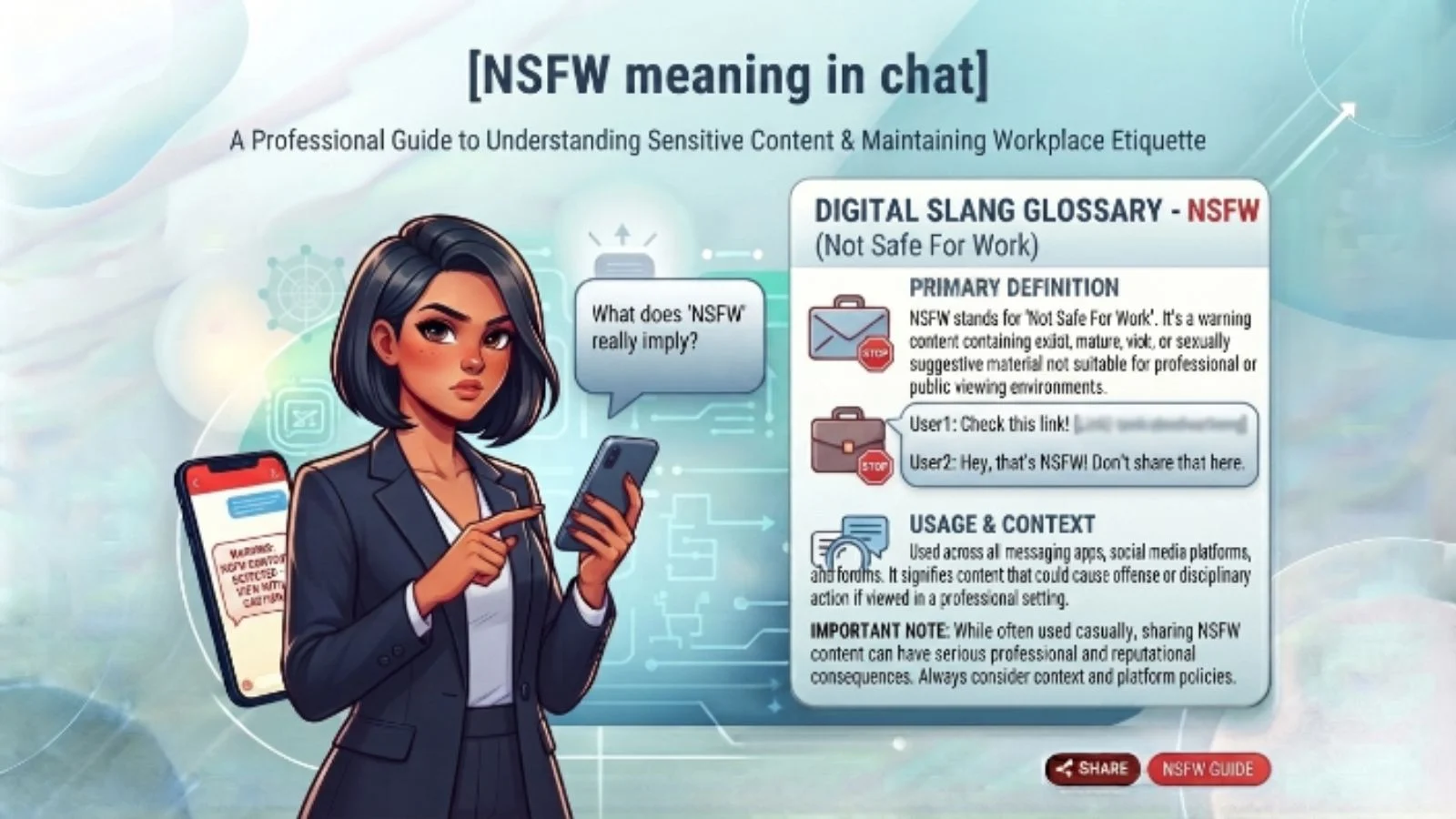
NSFW stands for “Not Safe For Work.”
In chat and online conversations, NSFW is a warning that the content may be inappropriate to view in a public, professional, or family-friendly environment.
The content could contain nudity, sexual material, graphic violence, disturbing images, strong language, or other material that someone may not want to appear on their screen while they are at work or around other people.
For example:
“I found a hilarious video, but it’s NSFW.”
This means the person is warning you that the video may contain content that is not appropriate to watch in a workplace or other public setting.
NSFW Meaning in Simple Words
In the simplest terms, NSFW means “be careful where you open this.”
It does not always mean that the content is illegal or extremely explicit. It simply signals that the material may be unsuitable for certain environments.
When someone labels something NSFW, they are essentially saying:
“This might be embarrassing, offensive, graphic, or inappropriate to view around coworkers, children, or strangers.”
The exact type of content can vary depending on the context.
What Can Be Considered NSFW?
NSFW can refer to content such as:
- Sexual or adult-oriented material
- Nudity
- Graphic violence or injuries
- Extremely disturbing images
- Offensive language
- Some shocking or controversial content
- Content that may violate workplace standards
The abbreviation is therefore broader than simply referring to sexual content.
Where Is NSFW Used?
You can encounter NSFW almost anywhere people communicate or share content online.
Common places include:
Text Messages
Friends may use NSFW before sending a link, image, or video.
Example:
“NSFW warning before you click this.”
Here, the sender is giving you advance notice that the material may not be appropriate to open in public.
Social Media
NSFW can appear in captions, comments, posts, or content warnings.
People may use it to help others decide whether they want to view particular material.
Reddit and Online Forums
NSFW is particularly common on online communities where users share a wide variety of content.
A post may be marked NSFW so users know that it contains mature or potentially inappropriate material.
Discord and Group Chats
People sometimes use NSFW labels when sharing adult-oriented jokes, images, videos, or other mature content.
The warning can be especially useful in large communities where users have different ages, preferences, and expectations.
Emails
You may occasionally see NSFW in an email subject line or message.
For example:
“NSFW: Don’t open this at work.”
The sender is warning you before you view the attachment or link.
Workplace Communication
Interestingly, NSFW can be especially important in professional environments.
If someone shares potentially inappropriate material, an NSFW warning gives the recipient an opportunity to avoid opening it in front of coworkers or during a meeting.
Why Do People Use NSFW?
The main purpose of NSFW is to provide a warning before someone views potentially inappropriate content.
Imagine that you’re sitting in a crowded office and receive a random link from a friend. Without a warning, you might open it immediately.
If the message says:
“NSFW — open this later.”
You know to wait.
This makes NSFW a practical form of digital etiquette.
People use it to:
- Warn others about mature content
- Prevent awkward situations
- Give viewers a choice
- Protect people from unexpectedly seeing disturbing material
- Identify content that may violate workplace expectations
- Make online communities easier to navigate
In other words, NSFW is less about the content itself and more about giving people a warning before they encounter it.
Examples of NSFW in Chat
Understanding examples is one of the easiest ways to learn internet slang.
Example 1
Person A: “Did you see that picture I sent?”
Person B: “Not yet.”
Person A: “NSFW, so don’t open it at work.”
Meaning: The sender is warning the recipient that the picture may contain inappropriate or mature material.
Example 2
Friend: “I found a crazy video. NSFW though.”
You: “I’ll watch it when I get home.”
Meaning: The friend is warning you that the video may not be suitable for a public or professional setting.
Example 3
Person A: “This meme is NSFW.”
Person B: “Thanks for the warning.”
Meaning: The meme contains material that could be inappropriate to view around coworkers or other people.
Example 4
Person A: “Don’t open that link during the meeting. NSFW.”
Meaning: The person is telling you to avoid opening the link because its content could be embarrassing or inappropriate in that situation.
NSFW vs Similar Internet Terms
NSFW is sometimes confused with other online labels. Although they can overlap, they don’t always mean exactly the same thing.
| Term | Meaning | Typical Use |
|---|---|---|
| NSFW | Not Safe For Work | Warns that content may be inappropriate in a workplace or public setting |
| SFW | Safe For Work | Indicates content is generally appropriate for professional or public viewing |
| 18+ | Intended for adults | Indicates an age restriction or mature audience |
| Mature | Contains adult or sensitive material | Used as a general content warning |
| CW | Content Warning | Warns about potentially upsetting or sensitive material |
| TW | Trigger Warning | Warns about specific content that may be distressing to some people |
NSFW vs 18+
These terms are related but not identical.
NSFW focuses mainly on where or around whom you should view the content.
18+ focuses more directly on the intended age of the audience.
Something can be NSFW without necessarily being labeled 18+, depending on the platform and context.
NSFW vs SFW
SFW means “Safe For Work.”
It is essentially the opposite of NSFW.
For example:
“Don’t worry, the link is SFW.”
This means the person believes you can safely open the content in a workplace or public setting.
When Should You Use NSFW?
You can use NSFW when sharing content that someone might reasonably want to avoid opening in public or professional surroundings.
For example:
“NSFW warning before you watch this.”
Or:
“This article contains some NSFW images.”
Or simply:
“NSFW link.”
The abbreviation is particularly useful when you want to warn someone without describing the content in detail.
When Should You Not Use NSFW?
NSFW should not be treated as a warning for absolutely anything surprising.
For example, a harmless joke that you personally dislike does not automatically need an NSFW label.
Likewise, content that is merely controversial, political, unpopular, or embarrassing may not necessarily be NSFW.
The label should provide a useful warning about the nature of the content.
Common Misunderstandings About NSFW
There are several misconceptions about this abbreviation.
1. NSFW Always Means Pornographic Content
Not necessarily.
Sexual or adult content is a common reason for an NSFW warning, but NSFW can cover other types of inappropriate or graphic material too.
Violent images, disturbing content, or extremely offensive material may also receive an NSFW label.
2. NSFW Means the Content Is Illegal
No.
NSFW is simply a content warning. It does not automatically indicate that the material is illegal.
The label describes suitability for a particular environment rather than determining the legal status of the content.
3. NSFW Means You Should Never Open It
Not necessarily.
The warning simply tells you to consider where you are and who is around you before opening it.
You might decide to view it later when you’re in a private and appropriate setting.
4. NSFW Is Only Used in Professional Offices
No.
The term originated around the idea of workplace suitability, but it is now widely used across social media, messaging apps, forums, gaming communities, and other online spaces.
Pro Tips for Understanding NSFW Messages
If someone sends you an NSFW message or link, a few simple habits can help.
Check the Warning Before Clicking
Don’t immediately open an NSFW link in a crowded place.
Take a moment to consider your surroundings.
Don’t Assume Every NSFW Label Means the Same Thing
One person may use NSFW for sexual content, while another may use it for graphic violence or disturbing imagery.
The safest approach is to treat the label as a general warning.
Consider Your Audience
If you’re sharing content with a group, remember that different people have different boundaries.
A warning gives people the opportunity to decide whether they want to view it.
Use Clear Warnings
If you are sharing potentially sensitive material, don’t rely only on the abbreviation when additional context would be helpful.
For example:
“NSFW — graphic violence.”
This gives the recipient more useful information than simply saying “NSFW.”
How to Respond When Someone Sends “NSFW”
You don’t need a complicated response.
Depending on the situation, you could say:
“Thanks for the warning.”
Or:
“I’ll check it later.”
Or:
“What kind of content is it?”
If you’re unsure whether it’s appropriate to open, asking for a little context is perfectly reasonable.
Is NSFW Still Used in 2026?
Yes. NSFW remains a widely recognized internet abbreviation in 2026, particularly in online communities, social media, forums, messaging platforms, and content-sharing spaces.
While platforms increasingly use automated content labels and safety filters, people still use NSFW as a quick, familiar warning.
Its meaning has also become broader over time. Instead of referring only to workplace concerns, NSFW can now signal content that someone may prefer not to see around family, friends, coworkers, children, or strangers.
Final Thoughts
So, what does NSFW mean in chat?
It stands for “Not Safe For Work” and is used as a warning that a message, image, video, link, or post may contain content that is inappropriate for a workplace, public environment, or other situation where you would want to be careful about what appears on your screen.
NSFW doesn’t always mean adult content. It can also refer to graphic, disturbing, offensive, or otherwise unsuitable material.
The easiest way to remember it is simple: NSFW means “think before you open this in public.”
Once you understand the abbreviation, you’ll know why people use it and how to respond when you see it in a text, social media post, or online conversation.
Frequently Asked Questions
What does NSFW mean in texting?
NSFW means “Not Safe For Work.” In texting, it warns you that a message, image, video, or link may contain mature, graphic, offensive, or otherwise inappropriate content.
Does NSFW always mean something sexual?
No. NSFW can refer to sexual or adult content, but it can also describe graphic violence, disturbing images, strong language, or other material that may be inappropriate in certain environments.
What does NSFW mean on social media?
On social media, NSFW is generally a warning that content may not be suitable for viewing in public, at work, or around certain audiences. It allows users to decide whether they want to view it.
What is the opposite of NSFW?
The opposite is commonly SFW, which means “Safe For Work.” It indicates that content is generally considered appropriate to view in a professional or public setting.