Have you ever seen someone mention SMS and wondered if it was just another internet slang term? You’re not alone. While many texting abbreviations have multiple meanings, SMS is different. It’s a technical term that most of us use every day without thinking about what it actually stands for.
Whether you’re sending a quick “Good morning,” receiving a bank verification code, or getting a delivery update, you’ve probably used SMS hundreds of times.
In this guide, you’ll learn exactly what SMS means in text message, how it works, where it’s used, and how it’s different from other messaging methods like MMS, iMessage, and chat apps.
What Does SMS Mean in Text Message?
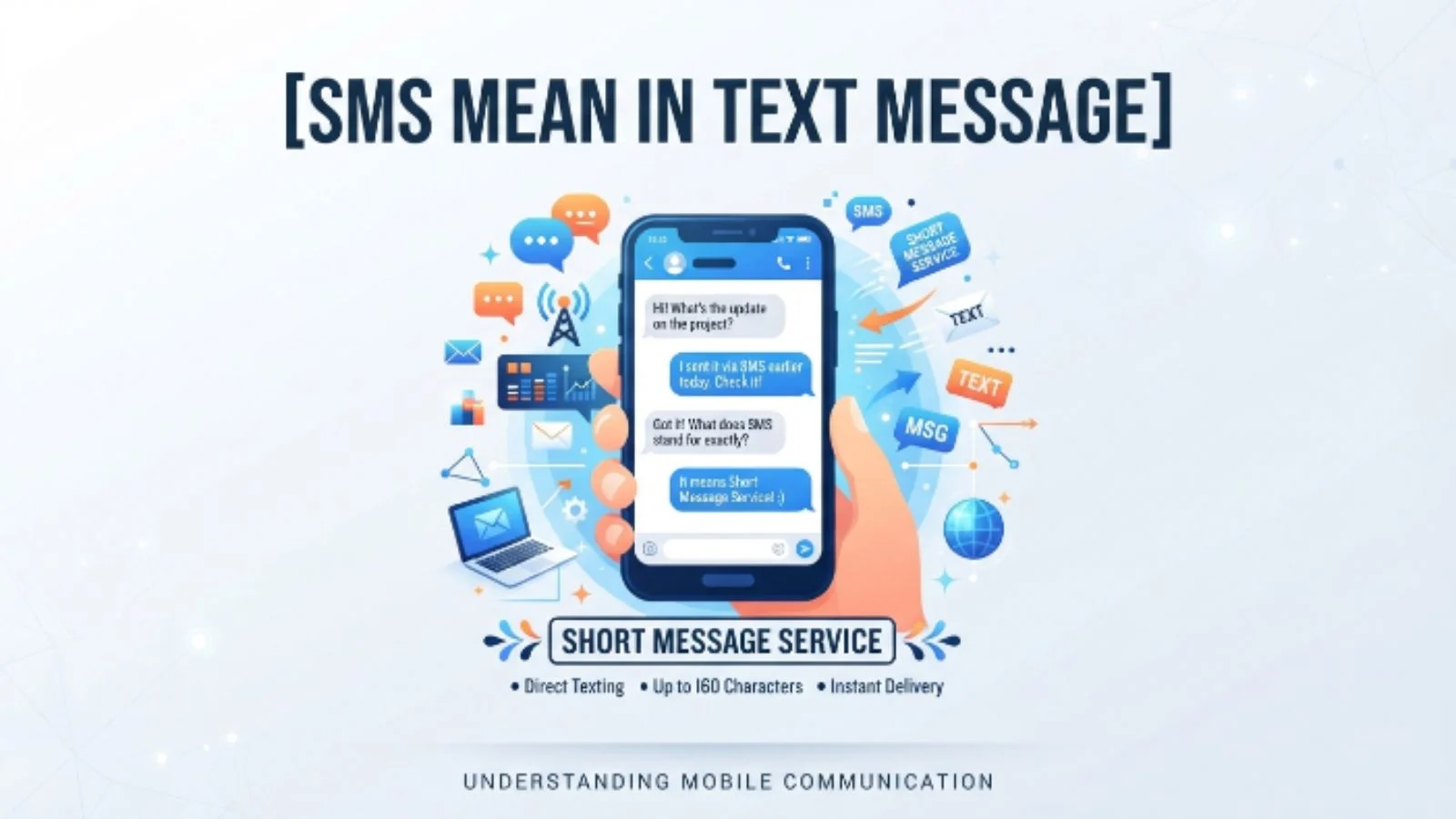
SMS stands for Short Message Service.
It is the standard technology used to send text-only messages between mobile phones over a cellular network.
Quick Definition
SMS means “Short Message Service,” a mobile communication service that allows users to send and receive text messages of up to 160 characters without needing an internet connection.
Unlike messaging apps such as WhatsApp or Messenger, SMS works through your mobile carrier instead of Wi-Fi or mobile data.
Simple Meaning of SMS
In simple words, SMS is the regular text message you send from your phone’s default messaging app.
Think of it like this:
- You type a message.
- You press Send.
- Your mobile network delivers it to the other person’s phone.
That’s SMS.
For example:
You: “I’ll be there in 10 minutes.”
If you sent that through your phone’s normal messaging app without using internet-based chat, you just sent an SMS.
What Does SMS Stand For?
Here’s the full form:
| Term | Meaning |
|---|---|
| SMS | Short Message Service |
The technology was developed to let mobile phones exchange short text messages quickly and efficiently.
Originally, one SMS message could contain 160 characters using the standard GSM alphabet. Longer messages are automatically divided and then combined when received.
Where Is SMS Used?
SMS is used almost everywhere because it works on nearly every mobile phone.
Some common places where you’ll see SMS include:
- Personal conversations
- Family communication
- Business notifications
- Banking alerts
- Appointment reminders
- School announcements
- Delivery updates
- Airline notifications
- Emergency alerts
- Government messages
- Password verification codes
- Two-factor authentication (2FA)
Since SMS doesn’t require internet access, it remains one of the most reliable communication methods worldwide.
Why Do People Use SMS?
Even with so many messaging apps available, SMS continues to be popular for several reasons.
1. No Internet Required
SMS works using your cellular network.
That means you can still send messages even when Wi-Fi isn’t available.
2. Works on Almost Every Phone
Whether someone has an Android phone, an iPhone, or even an older mobile phone, SMS usually works.
There is no need to install extra apps.
3. Fast Delivery
Most SMS messages arrive within seconds.
This makes SMS useful for urgent updates.
4. Trusted by Businesses
Banks, hospitals, online stores, and government agencies often send important notifications through SMS because almost everyone can receive them.
5. Great for Verification Codes
When you log into an account and receive a one-time password (OTP), it often arrives through SMS.
Real-Life Examples of SMS
Here are some everyday situations where SMS is used.
Example 1: Friend
Sarah: “Want to grab coffee after work?”
Emma: “Sure! I’ll meet you at 6.”
Explanation:
This is a normal SMS conversation sent using the mobile network.
Example 2: Bank
“Your verification code is 482931.”
Explanation:
Banks frequently use SMS to protect customer accounts.
Example 3: Online Shopping
“Your order has been shipped.”
Explanation:
Retailers often send delivery updates through SMS.
Example 4: Doctor’s Office
“Reminder: Your appointment is tomorrow at 10 AM.”
Explanation:
Healthcare providers use SMS to reduce missed appointments.
Example 5: School
“School will remain closed tomorrow due to weather conditions.”
Explanation:
Schools use SMS to quickly reach parents and students.
How Does SMS Work?
SMS may seem simple, but several systems work together behind the scenes.
The process looks like this:
- You type a message.
- Your phone sends it to your mobile carrier.
- The carrier forwards it through the SMS network.
- The recipient’s carrier receives it.
- The message is delivered to the recipient’s phone.
All of this usually happens in just a few seconds.
SMS vs Similar Messaging Terms
Many people confuse SMS with other messaging technologies.
Here’s an easy comparison.
| Feature | SMS | MMS | iMessage | |
|---|---|---|---|---|
| Internet Needed | No | No | Yes | Yes |
| Text Messages | Yes | Yes | Yes | Yes |
| Photos | No | Yes | Yes | Yes |
| Videos | No | Yes | Yes | Yes |
| Works on All Phones | Yes | Mostly | Apple Only | App Required |
SMS vs MMS
Although they look similar, SMS and MMS are different.
SMS
- Text only
- Up to 160 characters per message
- Uses cellular network
- No photos or videos
MMS
- Multimedia Messaging Service
- Can send:
- Pictures
- Videos
- GIFs
- Audio files
- Usually costs more depending on your mobile plan.
SMS vs Text Message
Many people ask:
Is SMS the same as a text message?
The answer is:
Usually, yes.
Most people use the words SMS and text message interchangeably.
Technically:
- Every SMS is a text message.
- Not every text message is SMS.
For example, messages sent through WhatsApp or iMessage are text messages, but they are not SMS because they use internet connections.
Common Places You’ll See SMS
You may encounter SMS in many everyday situations.
Examples include:
- Phone settings
- Online account verification
- Banking apps
- Delivery services
- Online shopping
- Medical reminders
- School notices
- Government services
- Social media login verification
- Customer support
When Should You Use SMS?
SMS is a good choice when:
- The other person may not have internet.
- You need a quick response.
- You’re sending important information.
- You’re communicating with someone who doesn’t use messaging apps.
- You’re receiving verification codes.
When SMS May Not Be the Best Choice
SMS isn’t perfect for every situation.
You might prefer another messaging service when:
- Sending lots of photos.
- Sharing videos.
- Making group conversations.
- Sending large documents.
- Making voice or video calls.
Messaging apps usually offer more features.
Advantages of SMS
SMS has remained popular for decades because it offers several benefits.
Advantages
- Works without internet
- Compatible with almost every phone
- Fast delivery
- Easy to use
- Reliable during emergencies
- Excellent for authentication
- Doesn’t require installing extra apps
Disadvantages of SMS
Like every technology, SMS also has limitations.
Disadvantages
- Limited message length
- No high-quality photos
- No video support
- No read receipts on standard SMS
- No typing indicators
- May have carrier charges
Common Misunderstandings About SMS
Many people misunderstand what SMS actually means.
Misunderstanding 1
SMS is internet messaging.
False.
SMS uses your cellular network.
Misunderstanding 2
SMS is another word for WhatsApp.
False.
WhatsApp uses the internet.
SMS uses your mobile carrier.
Misunderstanding 3
SMS can send large videos.
False.
SMS supports text only.
Videos are usually sent through MMS or internet messaging apps.
Misunderstanding 4
SMS only works on smartphones.
False.
Even many basic mobile phones support SMS.
Pro Tips for Using SMS
Follow these tips to make your SMS communication better.
Keep messages short
Short messages are easier to read.
Double-check phone numbers
Sending a message to the wrong person can create confusion.
Avoid sharing sensitive information
SMS is convenient but may not be the safest place for confidential information like passwords or financial details.
Watch for scam messages
Be careful with unexpected SMS messages asking you to click links or provide personal information.
Use SMS for urgent updates
Since it doesn’t rely on internet access, SMS is often one of the fastest ways to reach someone.
Is SMS Still Popular Today?
Yes.
Although messaging apps have become more popular, SMS remains an essential communication tool.
Businesses, banks, schools, hospitals, and governments continue to rely on SMS because it works on nearly every mobile phone.
Millions of SMS messages are sent every day around the world for alerts, reminders, confirmations, and personal conversations.
Final Thoughts
SMS may be one of the oldest mobile communication technologies, but it’s still incredibly useful. Simply put, SMS means Short Message Service, the standard way to send text-only messages through a mobile network without using the internet.
From chatting with friends to receiving bank alerts, appointment reminders, and verification codes, SMS continues to play an important role in everyday communication. Understanding what SMS means helps you choose the right messaging method for different situations and avoid confusing it with internet-based apps like WhatsApp or iMessage.
Frequently Asked Questions
What does SMS mean in text message?
SMS stands for Short Message Service. It is the standard technology used to send text-only messages through a mobile network.
Is SMS the same as a regular text message?
Most of the time, yes. People often use the terms SMS and text message interchangeably. However, internet-based messages sent through apps like WhatsApp or iMessage are not SMS.
Does SMS require internet?
No. SMS works through your mobile carrier’s cellular network and does not require Wi-Fi or mobile data.
Can SMS send photos and videos?
No. Standard SMS supports only text. To send multimedia files like photos or videos, you typically need MMS or an internet messaging app.
Is SMS free?
It depends on your mobile plan. Many carriers include unlimited SMS, while others may charge per message, especially for international texts.