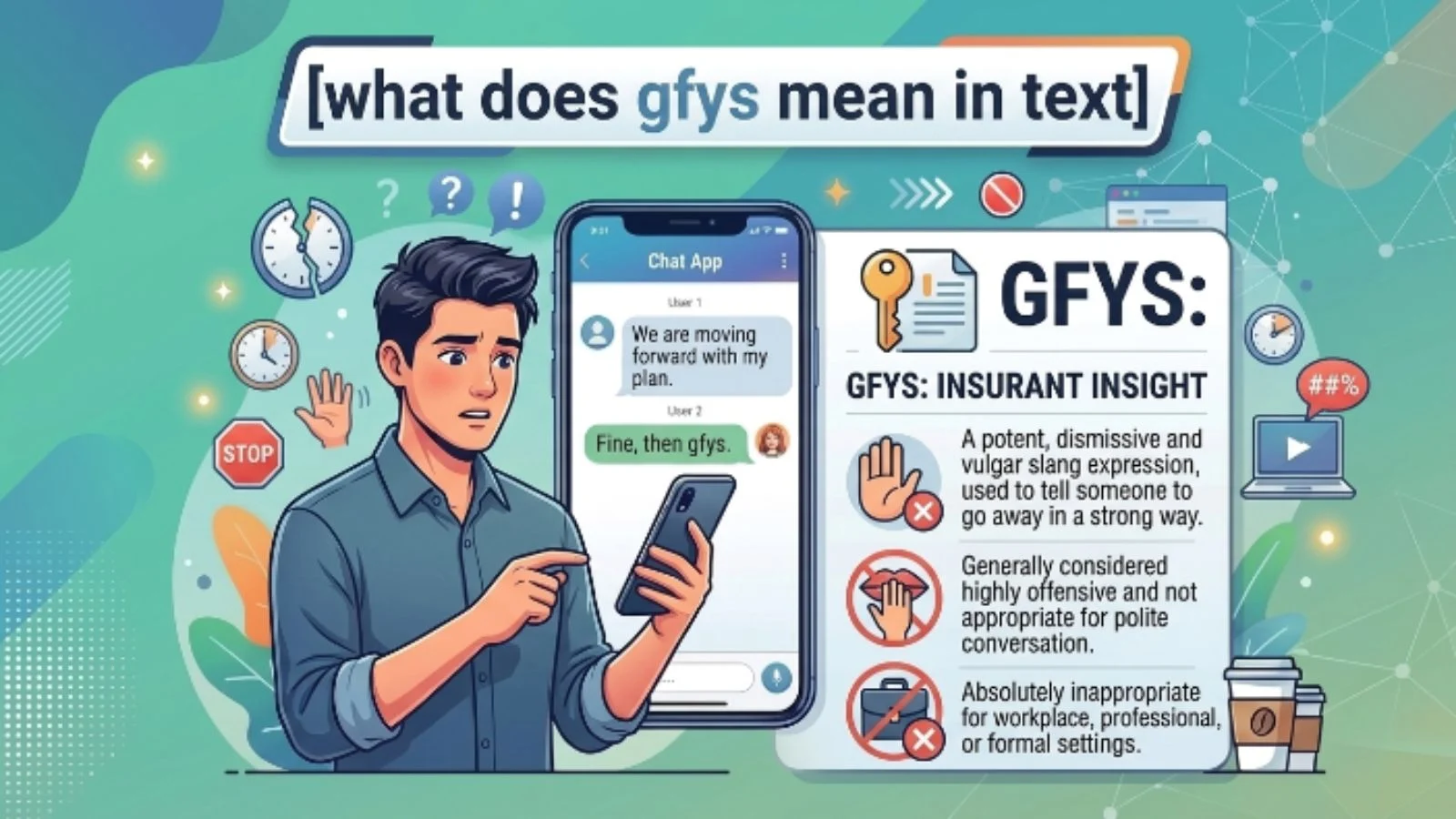
Have you ever received a text that simply says “GFYS” and wondered whether it was a joke, an insult, or something more serious?
Texting abbreviations can be confusing because a few letters can completely change the tone of a conversation. GFYS is one of those abbreviations that may sound harmless at first, but its meaning is usually rude and dismissive.
So, what does GFYS mean in text?
The most common meaning is “Go F* Yourself.”** It is a vulgar way to tell someone to go away or express strong anger, annoyance, or disrespect. However, the exact tone can depend on the conversation and the relationship between the people using it.
In this guide, you will learn what GFYS means, how people use it in texts and online conversations, whether it is always offensive, and how to respond if someone sends it to you.
What Does GFYS Mean in Text?
GFYS usually means “Go F* Yourself.”**
It is an insulting and vulgar expression used to show anger, frustration, rejection, or disrespect toward another person.
Because it contains profanity, GFYS is generally considered rude and offensive. Someone may use it during a serious argument, online disagreement, or heated conversation.
For example:
Person A: “You are completely wrong about this.”
Person B: “GFYS.”
In this example, the person is not politely disagreeing. They are using GFYS as a harsh way to end the conversation or insult the other person.
Quick Definition
GFYS means “Go F* Yourself” in text. It is a vulgar and offensive phrase used to express anger, rejection, or strong disagreement.**
The meaning is usually negative, although close friends may sometimes use it jokingly depending on their relationship and sense of humor.
What Is the Simple Meaning of GFYS?
In simple English, GFYS is a rude way of saying “go away” or “leave me alone.”
However, it is much stronger than simply saying:
- “Go away.”
- “Leave me alone.”
- “I don’t want to talk to you.”
- “Get lost.”
The phrase behind GFYS contains profanity, which makes it much more aggressive.
For this reason, you should be careful when using it. A message that seems funny to you could easily offend another person.
What Does GFYS Mean in Different Conversations?
The meaning of GFYS can change slightly depending on the situation.
1. GFYS as an Insult
The most common use is as a direct insult.
Example:
“You lied to me again. GFYS.”
Here, the sender is clearly angry and using the abbreviation aggressively.
2. GFYS as a Way to End an Argument
Some people use GFYS when they no longer want to continue a conversation.
Example:
“I’m done arguing with you. GFYS.”
In this case, the person is using the phrase to shut down the discussion.
3. GFYS as a Joke Between Friends
Close friends sometimes use offensive expressions jokingly.
Example:
Friend 1: “I ate the last slice of pizza.”
Friend 2: “GFYS.”
The meaning here may be playful rather than genuinely hostile. The friends may not actually be angry.
However, the relationship and tone are extremely important. The same message from a close friend might be a joke, while the same message from a stranger could be a serious insult.
4. GFYS in Online Arguments
GFYS may also appear during arguments on social media, gaming platforms, forums, or comment sections.
Someone might use it after a disagreement about:
- Politics
- Sports
- Gaming
- Entertainment
- Personal opinions
- Online debates
Because online conversations often lack facial expressions and voice tone, it can be difficult to know whether the sender is joking or genuinely angry.
Where Is GFYS Used?
You may see GFYS in many forms of digital communication, including:
- Text messages
- Instagram DMs
- Snapchat
- TikTok comments
- Facebook Messenger
- Discord
- Reddit discussions
- Online gaming chats
- X or other social platforms
- Private group chats
It is especially common in informal conversations where people use abbreviations to type quickly.
That said, GFYS is not appropriate for professional communication. You should not use it in emails to a manager, workplace messages, job applications, customer service conversations, or formal communication.
Why Do People Use GFYS?
People use GFYS for several reasons.
To Express Anger
Someone may use it when they are extremely frustrated or upset.
To Reject Someone
GFYS can be used as a harsh way to reject a request, opinion, or demand.
To End a Conversation
Some people use it when they do not want to continue arguing.
To Be Sarcastic
Friends may use GFYS jokingly when teasing each other.
To Save Time
Like many texting abbreviations, GFYS is shorter than writing the full phrase.
However, the fact that it is shorter does not make it less offensive.
Real-Life Examples of GFYS in Text
Understanding examples can help you recognize the tone.
Example 1: Serious Anger
Alex: “You promised you wouldn’t tell anyone.”
Sam: “GFYS. I don’t want to hear your excuses.”
Explanation: The phrase is being used aggressively. The person is clearly angry and wants to end the conversation.
Example 2: A Heated Online Argument
User 1: “Your opinion makes no sense.”
User 2: “GFYS.”
Explanation: Here, GFYS is being used as an insult during an argument.
Example 3: Playful Friendship
Friend 1: “I finished the whole cake before you got home.”
Friend 2: “GFYS, I was saving that!”
Explanation: In this situation, the abbreviation may be playful. The person may not genuinely be angry.
Example 4: Rejecting an Unreasonable Request
Person A: “Can you do all my work for me tonight?”
Person B: “GFYS.”
Explanation: The sender is strongly rejecting the request in a rude way.
Example 5: Ending a Toxic Conversation
Person A: “You will never be good enough.”
Person B: “GFYS. I’m done listening to you.”
Explanation: The phrase is being used to express anger and end an unpleasant conversation.
Is GFYS Always Offensive?
No, not always. But it is always potentially offensive because the phrase contains profanity.
The tone depends on several factors:
Your Relationship With the Person
A close friend may use GFYS jokingly. A stranger, coworker, or acquaintance may use it as a genuine insult.
The Conversation
If the conversation is already friendly and playful, GFYS may be teasing.
If the conversation involves an argument, the abbreviation is probably aggressive.
Punctuation and Context
Compare these examples:
“GFYS lol”
This may be playful between friends.
“GFYS.”
This can sound much harsher.
“GFYS!!!”
The multiple exclamation marks may suggest strong anger, although context still matters.
GFYS vs Similar Texting Terms
GFYS can be confused with other rude or dismissive expressions.
| Term | Meaning | Tone |
|---|---|---|
| GFYS | Go F*** Yourself | Extremely rude or aggressive |
| GTFO | Get the F*** Out | Very rude and forceful |
| FO | F*** Off | Rude and dismissive |
| STFU | Shut the F*** Up | Aggressive and insulting |
| IDC | I Don’t Care | Dismissive but usually less offensive |
| K | Okay | Can sound dismissive depending on context |
| SMH | Shaking My Head | Shows disappointment or disbelief |
| Whatever | Dismissive response | Can be rude but is less vulgar |
The important difference is that GFYS is one of the more direct and offensive expressions on this list.
GFYS vs “Go Away”
These phrases are not equal in strength.
“Go away” can be mildly annoyed or playful.
“GFYS” is much more aggressive and vulgar.
For example:
“Go away, I’m busy.”
This could be a normal request for space.
“GFYS.”
This communicates much stronger hostility.
When Should You Use GFYS?
In most situations, it is better not to use GFYS.
You might see it used among close friends who regularly joke with offensive language. Even then, you should be confident that the other person understands your humor.
Before sending GFYS, ask yourself:
- Is this person comfortable with this type of language?
- Are we genuinely joking?
- Could this message damage our relationship?
- Am I angry and likely to regret sending it?
- Is this a professional or public conversation?
If you are unsure, do not use it.
A safer alternative could be:
- “Please leave me alone.”
- “I’m done with this conversation.”
- “I strongly disagree.”
- “I don’t appreciate that.”
- “Let’s stop arguing.”
- “Please don’t contact me again.”
These phrases communicate your feelings without using profanity.
When Should You Avoid Using GFYS Completely?
You should avoid using GFYS in professional and formal situations.
Do not use it when communicating with:
- Your employer
- A teacher
- A client
- A customer
- A recruiter
- A business partner
- A government official
- Someone you do not know well
Even if you are frustrated, using GFYS can make you appear unprofessional and may create unnecessary problems.
It is also a bad idea to use it during serious personal conflicts when you are trying to solve a problem. A harsh insult can quickly turn a disagreement into a much bigger argument.
How Should You Respond If Someone Texts You GFYS?
Your response depends on the situation.
If They Are Clearly Angry
You can avoid escalating the argument.
Try:
“I can see you’re angry. Let’s talk when things have calmed down.”
If You Are Confused
You can ask:
“Are you being serious, or are you joking?”
This can help clarify the tone.
If You Feel Insulted
You can set a boundary:
“I don’t appreciate being spoken to that way.”
If It Is a Close Friend
You may respond playfully if you understand the context.
For example:
“Wow, rude.”
or:
“Right back at you.”
However, only use a joking response if you are certain the situation is friendly.
If It Is Harassment
You do not have to continue the conversation. You can ignore, block, or report the person depending on the situation and platform.
Common Misunderstandings About GFYS
Misunderstanding 1: GFYS Is Always a Joke
Not necessarily.
Some people use it jokingly, but others use it as a serious insult. You need to consider the full conversation.
Misunderstanding 2: The Abbreviation Makes It Less Offensive
Writing GFYS instead of the full phrase does not remove the offensive meaning.
The abbreviation is still understood by many people as profanity.
Misunderstanding 3: GFYS Has Only One Possible Tone
The phrase can be:
- Angry
- Sarcastic
- Playful
- Hostile
- Dismissive
Context determines the tone.
Misunderstanding 4: You Can Use It Anywhere
You should not use GFYS in professional or formal communication.
Informal texting language does not belong in every conversation.
Pro Tips for Understanding GFYS
Pay Attention to the Conversation Before It
The messages leading up to GFYS often reveal the real meaning.
Was the conversation playful, or were people arguing?
Consider the Person Who Sent It
A close friend may use it differently from a stranger.
Look at the Tone of the Message
Words like “lol,” “lmao,” or playful emojis may suggest joking. However, never rely on one word alone.
Do Not Respond Emotionally Too Quickly
If someone sends you GFYS during an argument, replying with another insult may make the situation worse.
Take a moment before responding.
Ask for Clarification When Necessary
If you are unsure, simply ask:
“What do you mean by that?”
Sometimes the person may explain that they were joking.
Can GFYS Have Other Meanings?
The most common meaning of GFYS in text slang is “Go F* Yourself.”**
However, abbreviations can occasionally have different meanings in specific communities, workplaces, games, or private groups.
That is why context always matters.
If you see GFYS in a conversation and the usual meaning does not make sense, consider the surrounding messages before assuming what the sender intended.
Still, in ordinary texting and social media conversations, the vulgar meaning is the one most people are likely to understand.
Frequently Asked Questions
What does GFYS mean in texting?
GFYS most commonly means “Go F* Yourself.”** It is a vulgar expression used to show anger, rejection, frustration, or disrespect.
Is GFYS a bad word?
Yes. GFYS is considered offensive because it contains profanity. It may be used jokingly among close friends, but it can still offend people depending on the situation.
Is GFYS always meant seriously?
No. Close friends may use GFYS sarcastically or playfully. However, during an argument, it is usually meant as a serious insult or aggressive response.
What should I reply to GFYS?
You can ask whether the person is serious, calmly explain that you do not appreciate the language, or end the conversation. Avoid responding with another insult if you want to prevent the argument from escalating.
Final Thoughts
So, what does GFYS mean in text? It most commonly means “Go F* Yourself,”** a rude and vulgar expression used to show anger, rejection, or strong disagreement.
The meaning can sometimes be playful between close friends, but you should never assume that everyone will understand it as a joke. Context, relationship, and tone are important.
If someone sends you GFYS, look at the conversation before deciding how to respond. And if you are thinking about using it yourself, remember that a less offensive phrase can often communicate the same feeling without creating unnecessary conflict.