If you saw someone write “han” in a message, you may feel confused.
Is it a typo?
Is it slang?
Does it mean yes or no?
In this simple 2026 guide, you will learn:
- The clear meaning of “han” in text
- Where it comes from
- How people use it today
- Real chat examples
- Common mistakes
- FAQs people ask online
This guide uses easy English so everyone can understand.
Let’s start.
What Does “Han” Mean in Text?
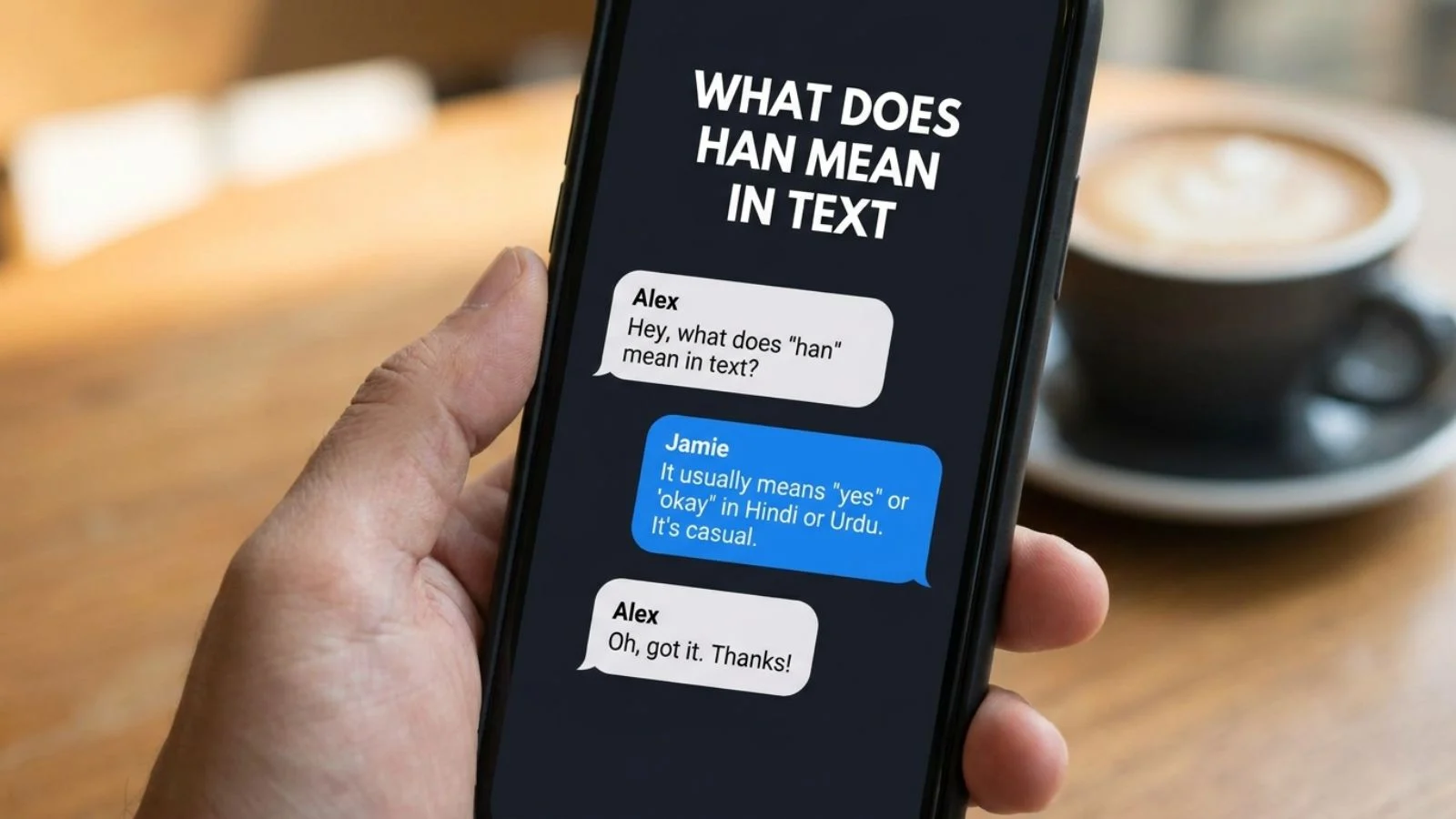
In most text messages, “han” means “yes.”
It is often used in:
- Urdu
- Hindi
- Roman Urdu texting
- Casual chat between friends
In simple words:
Han = Yes
People write “han” instead of “haan” or “haan ji” when typing fast.
Simple Definition
Han (text slang): A casual way to say “yes” in Roman Urdu or Hindi while chatting online.
It is friendly and informal.
Why Do People Write “Han” Instead of “Yes”?
There are three main reasons:
1. Cultural Language Habit
In Pakistan and India, many people speak Urdu or Hindi at home.
When they type in English letters, they write how they speak.
So:
- Haan → Han
- Ji haan → Han ji
2. Fast Typing
Short words save time.
“Han” is faster than typing:
- Yes
- Yeah
- Yup
3. Casual Internet Style
In chat apps like:
- Facebook Messenger
- Snapchat
People type quickly and casually. Spelling does not need to be perfect.
Is “Han” an English Word?
No.
“Han” is not standard English.
It is a Roman Urdu or Hindi transliteration.
That means:
People write Urdu or Hindi sounds using English letters.
Example:
| Spoken Word | Text Version |
|---|---|
| Haan | Han |
| Theek hai | Theek ha |
| Kya | Kya |
So “han” is not English grammar. It is local texting style.
Origin and History of “Han” in Texting
Spoken Language First
The word “haan” has been used for hundreds of years in:
- Urdu
- Hindi
- Punjabi
It simply means yes.
SMS Era (2000–2010)
When mobile texting became popular:
- Phones had small keypads.
- Typing was slow.
- People shortened words.
So “haan” became “han.”
Social Media Growth (2015–2026)
With the rise of:
- TikTok
Roman Urdu became very common.
In 2026, many young people in Pakistan and India type in Roman Urdu daily.
That is why “han” is very common now.
Different Ways “Han” Is Written in Text
People spell it in many ways.
| Version | Meaning |
|---|---|
| Han | Yes |
| Haan | Yes (longer sound) |
| Ha | Yes (very short) |
| Han ji | Yes (respectful) |
| Hnj | Very short texting style |
All mean yes, but tone changes slightly.
Tone and Personality Behind “Han”
The meaning is simple. But tone depends on how it is written.
1. Friendly Han
“Han, bilkul!”
This shows excitement and agreement.
Personality: Warm and positive.
2. Bored Han
“Han.”
Just one word with a period.
Personality: Maybe annoyed or uninterested.
3. Respectful Han
“Han ji.”
Personality: Polite and respectful.
4. Romantic Han
“Han jaan.”
Personality: Loving and sweet.
So always look at the full message, not just the word.
Real-Life Chat Examples (With Simple Explanation)
Example 1: Simple Agreement
A: Are you coming today?
B: Han.
Explanation: B is saying yes.
Example 2: Excited Yes
A: Party tonight?
B: Han yaar, of course!
Explanation: B is happy and excited.
Example 3: Polite Response
Mother: Beta, khana kha liya?
Son: Han ji.
Explanation: He is answering respectfully.
Example 4: Slightly Annoyed
Friend: You forgot again?
You: Han.
Explanation: Short answer. Might show irritation.
Example 5: Romantic Chat
Boy: Miss me?
Girl: Han bohat.
Explanation: She is saying yes, very much.
Is “Han” Always Positive?
Usually yes.
But tone can change meaning.
Positive Use
- Agreeing
- Confirming
- Supporting
Neutral Use
- Simple reply
- Short answer
Negative Feeling (Sometimes)
If someone replies only “Han” with no emotion, it may show:
- Boredom
- Anger
- Lack of interest
So context is very important.
Modern Usage of “Han” in 2026
In 2026, “han” is used in:
1. Voice Notes + Text Mix
Example:
“Han I sent the file, check karo.”
This is a mix of English and Urdu.
2. Instagram Comments
“Han yeh sahi kaha.”
Used in reels and posts.
3. Gaming Chats
“Han bro ready.”
Common in PUBG and other online games.
4. Workplace Casual Chat
In informal offices:
“Han I will send it by 5.”
But not in formal emails.
When NOT to Use “Han”
Do not use “han” in:
- Job applications
- Official emails
- Academic writing
- Business proposals
Instead use:
- Yes
- Certainly
- Of course
Example:
Wrong: Han sir I completed the task.
Correct: Yes sir, I have completed the task.
Common Mistakes and Misconceptions
Mistake 1: Thinking “Han” Is English
It is not standard English.
It is Roman Urdu/Hindi.
Mistake 2: Confusing It With “Hun”
In American slang, “hun” means:
Short for honey.
Example: “Thanks hun.”
That is different from “han.”
Mistake 3: Confusing With Korean “Han”
In Korean culture, “han” can mean deep sadness.
That is completely different.
In South Asian texting, “han” simply means yes.
Mistake 4: Thinking It Is Rude
“Han” is not rude.
But very short replies can feel cold.
Tone depends on situation.
Personality Traits of People Who Use “Han”
People who use “han” often:
- Are bilingual (Urdu/Hindi + English)
- Prefer casual texting
- Type quickly
- Use Roman Urdu daily
- Feel comfortable mixing languages
It shows relaxed and informal communication style.
Comparison: Han vs Yes vs Yeah
| Word | Formal? | Casual? | Region |
|---|---|---|---|
| Yes | Formal | Neutral | Global |
| Yeah | Casual | Yes | English-speaking countries |
| Han | Informal | Very casual | Pakistan/India |
Each word fits different situations.
How to Reply When Someone Says “Han”
It depends on the topic.
If they say:
“Han I agree.”
You can reply:
- Great
- Perfect
- Thanks
- Let’s do it
If they say:
“Han.” (only one word)
You may ask:
- Everything okay?
- Why so serious?
Always read tone carefully.
Emotional Meaning Behind Short Replies
In texting, short words feel stronger.
Example:
Han = Basic agreement
Haan!!! = Excited yes
Han… = Unsure yes
Small changes matter.
That is how digital tone works.
Cultural Importance of “Han”
In South Asian culture:
- Language mixing is normal.
- English + Urdu combo is common.
- Roman Urdu is widely used online.
“Han” is part of that digital culture.
It reflects:
- Identity
- Region
- Informal bonding
It is more than just “yes.”
It shows belonging.
Mini Dialogue Practice Section
Dialogue 1
Teacher: Did you finish homework?
Student: Han miss.
Explanation: Student says yes politely.
Dialogue 2
Friend 1: Movie tonight?
Friend 2: Han chal.
Explanation: Agreeing casually.
Dialogue 3
Boss: Are you available for meeting?
Employee: Yes sir.
Explanation: Formal setting, so not “han.”
Dialogue 4
Crush: You care about me?
You: Han, bohat.
Explanation: Romantic yes.
How Parents Can Understand This Word
If your child types “han”:
Do not worry.
It simply means:
“Yes.”
It is not secret slang.
It is normal youth texting.
Why People Search “What Does Han Mean in Text?”
Common reasons:
- Saw it in WhatsApp
- Received from crush
- Saw in Instagram comment
- Confused about tone
- Not from South Asia
Many English speakers outside Pakistan/India do not know this word.
That is why this keyword is popular in 2026.
FAQs About “Han” in Text
1. What does han mean in text messages?
It means yes in Roman Urdu or Hindi.
2. Is han rude?
No. It is not rude.
Tone depends on context.
3. Is han the same as haan?
Yes. “Haan” is the full spelling.
“Han” is shortened.
4. Can I use han in formal emails?
No. Use “Yes” in formal writing.
5. Is han used worldwide?
Mostly in Pakistan and India.
Not common in Western countries.
6. What does han ji mean?
It means yes with respect.
“Ji” adds politeness.
7. Why do people mix English and Urdu in texting?
Because bilingual speakers feel comfortable mixing both languages.
It is fast and natural.
Final Summary Table
| Question | Simple Answer |
|---|---|
| Meaning | Yes |
| Language | Roman Urdu/Hindi |
| Formal? | No |
| Tone | Depends on context |
| Popular in | Pakistan & India |
| Safe to use? | Yes, in casual chat |
Conclusion
Now you clearly understand what “han” means in text. It simply means yes, especially in Roman Urdu or Hindi chat. It is informal, friendly, and widely used in Pakistan and India. Tone depends on how it is written and the situation. Do not use it in formal emails, but it is perfectly normal in casual messages. Language online keeps changing, and words like “han” show how cultures mix in digital spaces. If you found this guide helpful, keep exploring modern texting meanings to stay confident and updated in 2026 and beyond.