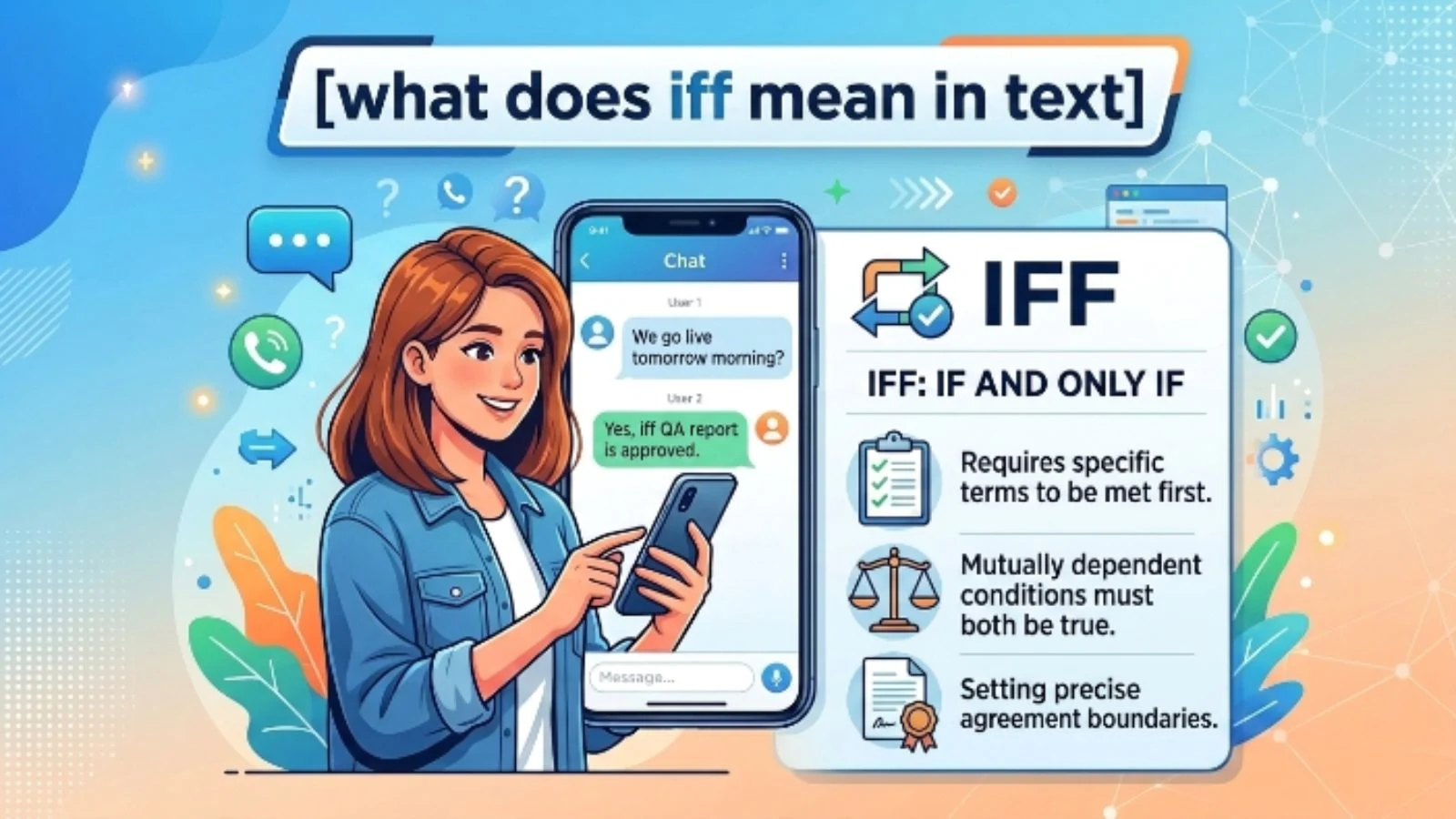
Have you received a text with “IFF” and wondered what the person actually meant? You are not alone. Short forms can make texting faster, but they can also create confusion, especially when the same abbreviation may have different meanings depending on the conversation.
So, what does IFF mean in text?
In most casual texting and online conversations, IFF means “If and Only If.” It is commonly used to show that something is true only when a specific condition is also true. However, the abbreviation can have other meanings in specialized contexts, so the surrounding conversation always matters.
In this guide, you will learn the meaning of IFF, how people use it, real-life examples, similar terms, common misunderstandings, and when you should or should not use it.
What Does IFF Mean in Text?
IFF usually means “If and Only If.”
It is used to express a condition with two parts:
- One thing happens if another thing happens.
- The second thing also happens only if the first condition is true.
In simple terms, “if and only if” means that both conditions must work together.
Simple Example
“You can enter the competition IFF you are registered.”
This means:
You can enter the competition if you are registered, and you can enter only when you are registered.
The word IFF is more precise than simply saying “if.”
Featured Snippet Definition
IFF in text usually means “if and only if.” It describes a condition where something is true only when another specific condition is also true. The abbreviation is especially common in academic, technical, mathematical, and logical conversations.
What Is the Simple Meaning of IFF?
The easiest way to understand IFF is to think of it as:
“This is true only when that is true, and vice versa.”
For example:
“You get the discount IFF you have a membership.”
This means:
- If you have a membership, you get the discount.
- If you get the discount, you must have a membership.
Both sides are connected.
This is why IFF is stronger and more specific than the ordinary word “if.”
“If” vs. “IFF”
Consider these two sentences:
If:
“You can join if you are invited.”
This usually means being invited is enough to join.
IFF:
“You can join IFF you are invited.”
This means being invited is both necessary and sufficient for joining.
That difference is important in mathematics, computer science, formal logic, and technical writing.
What Does IFF Stand For?
IFF stands for “if and only if.”
It is sometimes written in capital letters as IFF to make the abbreviation easy to recognize. You may also see the phrase written in lowercase as iff, particularly in academic or technical writing.
The abbreviation is not usually pronounced as separate letters. In many academic settings, people pronounce it like the word “if.”
Where Is IFF Used?
Although you may occasionally see IFF in online messages, it is more common in situations where people need to express an exact condition.
1. Academic Conversations
Students and teachers may use IFF when discussing logic, mathematics, or formal arguments.
Example:
“The equation works IFF x is greater than zero.”
This means the equation works exactly when the condition is met.
2. Mathematics and Logic
This is one of the most common uses of IFF.
In mathematical logic, “if and only if” describes a two-way relationship between statements.
For example:
“A number is even IFF it is divisible by 2.”
The statement works in both directions:
- If a number is even, it is divisible by 2.
- If a number is divisible by 2, it is even.
3. Computer Science and Programming
People working in programming, software development, algorithms, and computer science may use IFF to describe conditions.
Example:
“The function returns true IFF the user is authenticated.”
This means the function returns true only when the user is authenticated, and authentication is the required condition for the result.
4. Online Forums and Social Media
You may see iff in online discussions, especially in communities focused on:
- Mathematics
- Programming
- Technology
- Science
- Academic subjects
- Logic and philosophy
It is less common in casual conversations than abbreviations such as IDK, BTW, or LMK.
5. Text Messages
Someone might use IFF in a text when they want to express a strict condition.
For example:
“I’ll help you with the project iff you help me with mine.”
In casual texting, however, many people would simply write “if and only if” because the abbreviation may not be familiar to everyone.
Why Do People Use IFF?
There are several reasons someone may use IFF instead of writing the full phrase.
It Saves Time
Typing IFF is faster than typing “if and only if.”
This can be useful in long technical explanations or fast-paced conversations.
It Is Precise
The word “if” can sometimes be vague. IFF makes it clear that the relationship works in both directions.
It Is Common in Technical Fields
Students, programmers, mathematicians, and researchers may use IFF because it is a standard abbreviation in their fields.
It Makes Complex Ideas Shorter
A complicated explanation can become easier to read when repeated phrases are shortened.
For example:
“The system works if and only if the correct password is entered.”
Can become:
“The system works IFF the correct password is entered.”
Real-Life Examples of IFF in Text
Here are some examples showing how IFF may appear in messages and online conversations.
Example 1: School
“You can take the final exam IFF you complete all assignments.”
Meaning: You can take the exam only when all assignments are completed.
The condition is strict. Completing the assignments is required.
Example 2: Work
“The application will be approved IFF all documents are submitted.”
Meaning: Approval depends on submitting all required documents.
The application will not be approved without the necessary documents.
Example 3: Gaming
“You unlock the next level IFF you defeat the boss.”
Meaning: Defeating the boss is the exact condition needed to unlock the next level.
Example 4: Programming
“The program runs IFF the required files are installed.”
Meaning: The program runs only when the required files are available.
Example 5: Everyday Conversation
“You can borrow my car IFF you promise to drive carefully.”
Meaning: The promise to drive carefully is a condition for borrowing the car.
Example 6: Online Discussion
“This argument is valid IFF the original assumption is true.”
Meaning: The argument is valid only when the original assumption is true, and the relationship works in both directions.
IFF vs. IF: What Is the Difference?
This is one of the most important distinctions.
| Term | Meaning | Example |
|---|---|---|
| If | Introduces a condition | “I will go if you invite me.” |
| IFF | Means “if and only if” | “I will go IFF you invite me.” |
| Only if | Shows a necessary condition | “I will go only if you invite me.” |
The key point is that IFF expresses a two-way condition.
Understanding the Difference
Suppose someone says:
“You pass if you study.”
This does not always mean studying is the only way to pass.
But:
“You pass IFF you study.”
means studying is directly connected to passing in both directions.
In formal situations, this distinction can be extremely important.
IFF vs. “Only If”
The phrase “only if” is similar to IFF, but it is not exactly the same.
For example:
“You can enter only if you have a ticket.”
This means having a ticket is necessary for entry.
But it does not automatically say that everyone with a ticket can enter.
With IFF:
“You can enter IFF you have a ticket.”
the relationship is presented as a two-way condition.
That is why IFF is more precise in formal logic and mathematics.
IFF vs. “Unless”
Unless means something different.
Example:
“You cannot enter unless you have a ticket.”
This means a ticket is necessary.
However:
“You can enter IFF you have a ticket.”
creates a more exact two-way relationship.
Although these expressions may sometimes appear similar in everyday conversation, they are not always interchangeable in technical writing.
When Should You Use IFF?
You should use IFF when the person reading your message is likely to understand the abbreviation and when you need to express a strict two-way condition.
It is useful in:
- Mathematics
- Logic
- Computer science
- Programming
- Academic discussions
- Technical explanations
- Online communities focused on science or technology
For example:
“The theorem is true IFF the condition is satisfied.”
This is appropriate in a technical discussion.
When Should You Avoid Using IFF?
You may want to avoid IFF in casual conversations if the other person may not know what it means.
For example, sending this to someone unfamiliar with the abbreviation:
“I’ll come IFF you send me the address.”
could cause confusion.
A clearer version would be:
“I’ll come if and only if you send me the address.”
Or, in a casual conversation:
“I’ll come only if you send me the address.”
The best abbreviation is always the one your reader understands.
Common Misunderstandings About IFF
Misunderstanding 1: IFF Means the Same as IF
This is not completely correct.
If generally introduces a condition.
IFF means “if and only if,” which creates a two-way relationship.
Misunderstanding 2: IFF Is a Common Casual Texting Slang Term
Not usually.
Unlike popular texting abbreviations such as LOL, BRB, or TBH, IFF is more strongly associated with academic, technical, and logical contexts.
Someone may use it in a text, but it is not one of the most common everyday texting abbreviations.
Misunderstanding 3: IFF Always Has One Meaning
Context matters.
In most academic or logical contexts, IFF means “if and only if.” However, abbreviations can have different meanings in different industries, organizations, or conversations.
If the message does not seem to make sense, consider the surrounding context before assuming the meaning.
Misunderstanding 4: Everyone Understands IFF
Many people do not.
If you are writing for a general audience, spelling out “if and only if” may be clearer.
How to Understand IFF From Context
When you see IFF in a message, ask yourself:
- Is the conversation about mathematics or logic?
- Is the person discussing programming or technology?
- Does the sentence describe a strict condition?
- Could “if and only if” fit naturally in the sentence?
For example:
“The account is verified IFF the email is confirmed.”
The phrase “if and only if” fits naturally, so that is likely the intended meaning.
If the abbreviation appears in a completely different context, the meaning may require further clarification.
Pro Tips for Using IFF Correctly
1. Use It When Precision Matters
IFF is most useful when you want to show that a condition works in both directions.
2. Consider Your Audience
Do not assume everyone knows technical abbreviations.
For a general audience, writing the full phrase may be better.
3. Do Not Use IFF Just to Sound Technical
Using an abbreviation does not automatically make writing clearer.
If the sentence is easier to understand with “if and only if,” use the full phrase.
4. Look at the Full Conversation
The meaning of any abbreviation depends on context. The words before and after IFF can help you understand what the sender intended.
5. Remember the Two-Way Relationship
The most important thing to remember is that IFF is not simply another version of “if.”
It indicates a condition that works both ways.
Is IFF Formal or Informal?
IFF is generally more formal or technical than casual.
You may see it in:
- Academic writing
- Mathematical proofs
- Computer science
- Technical chats
- Programming discussions
It is less common in everyday texting between friends.
If someone sends you IFF in a casual conversation, they may be using it because they are comfortable with technical language, or they may simply be shortening the phrase.
Final Thoughts: What Does IFF Mean in Text?
So, what does IFF mean in text?
In most cases, IFF means “if and only if.” It describes a strict two-way condition, meaning something is true when another condition is true, and that condition is also necessary for the original statement.
You will most often see IFF in mathematics, logic, programming, academic discussions, and technical conversations. It can appear in text messages too, but it is not as common as everyday abbreviations such as LOL or IDK.
The easiest way to remember it is simple: IFF means “if and only if,” not just “if.” When you see it in a message, check the surrounding context and replace it mentally with the full phrase. If the sentence makes sense, you have probably found the correct meaning.
Frequently Asked Questions
What does IFF mean in text messages?
IFF usually means “if and only if.” It expresses a strict condition where something is true only when another specific condition is also true.
Is IFF a common texting abbreviation?
IFF is not one of the most common casual texting abbreviations. It is more frequently used in mathematics, logic, programming, academic discussions, and technical conversations.
What is the difference between IF and IFF?
If introduces a condition, while IFF means “if and only if” and expresses a two-way relationship between two conditions or statements.
Can I use IFF in everyday texting?
Yes, you can, but only if the other person understands the abbreviation. In general conversations, writing “if and only if” may be clearer.