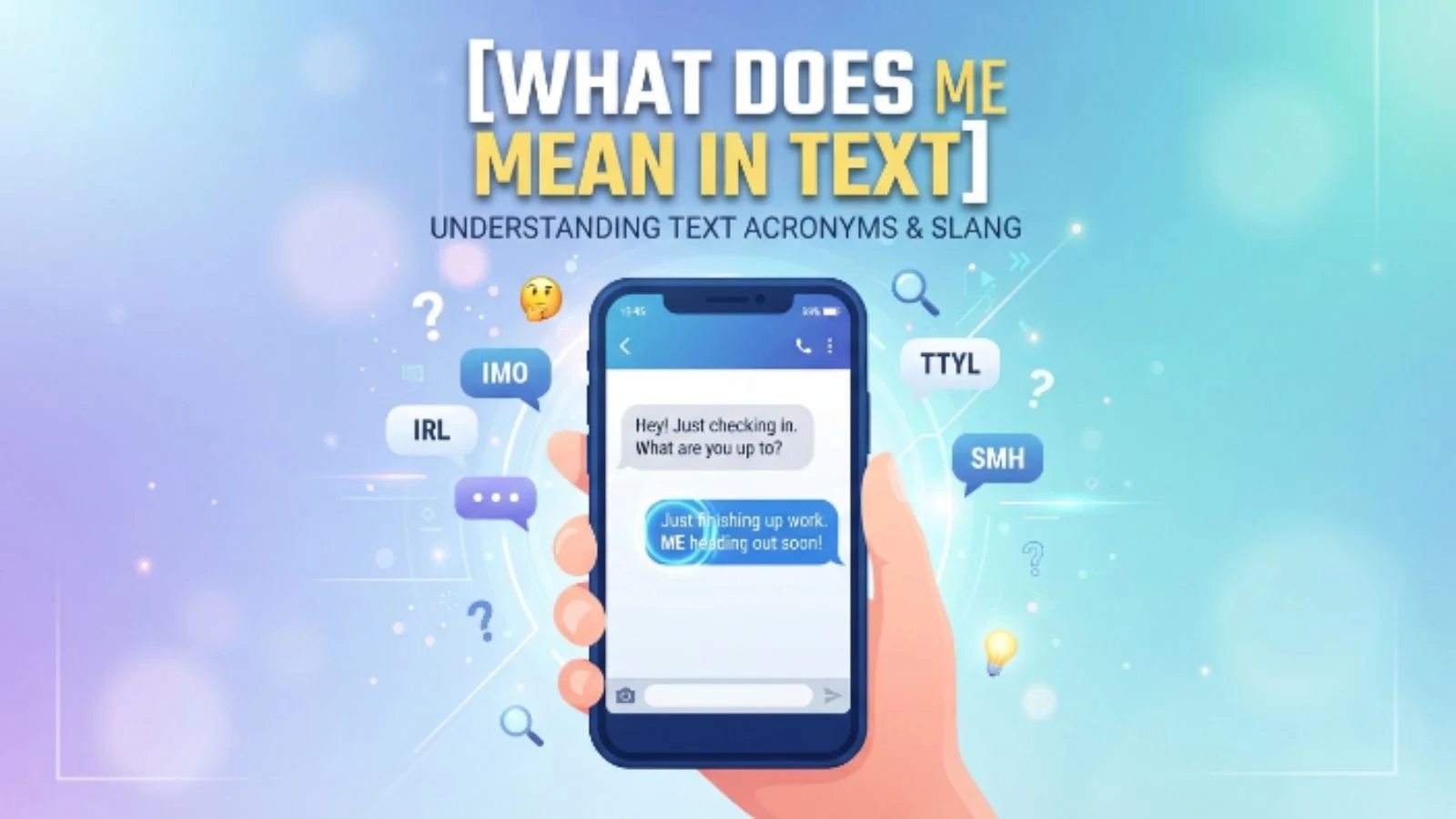
Have you ever received a text containing “me” and wondered whether it has a special slang meaning? Sometimes a short word can seem confusing when it appears in a meme, social media comment, or casual message.
The good news is that “me” usually has its normal English meaning. However, online conversations often use it in funny, emotional, sarcastic, or relatable ways. The exact meaning depends on the sentence and the context.
In this guide, you will learn exactly what does me mean in text, how people use it online, what it means in memes, and how to understand it correctly.
What Does “ME” Mean in Text?
In text messages, “me” usually means the person who is speaking or writing. It is the first-person object pronoun used when someone is talking about themselves.
For example:
“She called me.”
Here, “me” refers to the person receiving the message.
However, in internet slang and social media conversations, “me” can also be used as a short reaction meaning “This is exactly how I feel” or “This describes me.”
For example:
“Me after saying I’ll go to bed early: watches videos until 3 a.m.”
The word “me” means:
“That is exactly what I do.”
Quick Definition
“Me” in text usually means the speaker or writer themselves. In memes and online conversations, it can also mean “this is relatable to me” or “this describes my behaviour.”
Simple Meaning of “Me” in Text
The simplest meaning of “me” is “myself” or “the person speaking.”
Consider this example:
“Can you send me the notes?”
The person is asking for the notes to be sent to them.
Another example is:
“He told me the news.”
In this sentence, “me” refers to the person who received the information.
But online, the word can be used in a more expressive way.
For example:
“Me pretending I understand the assignment.”
This usually means:
“I am pretending that I understand the assignment.”
The person may use “me” at the beginning of a meme or caption to show that the situation represents their own behaviour.
What Does “Me” Mean in Memes and Social Media?
On platforms such as Instagram, TikTok, Facebook, X, Reddit, and Snapchat, “me” is often used to show identification with a situation.
Someone may see a funny post and comment:
“Me.”
This means:
- “This is exactly like me.”
- “I do this too.”
- “I can relate to this.”
- “This describes my life.”
For example, imagine a meme saying:
“Says ‘I’m not hungry’ and then eats everyone else’s food.”
Someone might comment:
“Me.”
They are jokingly admitting that the meme describes their behaviour.
This use is extremely common in informal online communication.
Why Do People Use “Me” in Texts?
People use “me” for several different reasons depending on the conversation.
1. To Refer to Themselves
The most common use is simply referring to the person speaking.
“Please call me later.”
Here, “me” means the person who sent the message.
2. To Show Relatability
People often reply with “me” when something perfectly describes them.
Person A: “I spend five minutes looking for my phone while holding it.”
Person B: “Me.”
The second person means:
“I do that too.”
3. To Make a Joke
“Me” can introduce a funny contrast between what someone says and what they actually do.
“Me: I’m only going to watch one episode.”
Also me: finishes the entire series.
This format is popular because it shows a relatable situation in a short and humorous way.
4. To Express an Emotional Reaction
Sometimes “me” is used to show that someone strongly identifies with a feeling.
“Me trying not to cry during emotional movies.”
This means:
“This is what I am like when I watch emotional movies.”
Where Is “Me” Used?
You can see the word “me” almost everywhere in digital communication.
Text Messaging
In regular texts, “me” usually has its standard grammatical meaning.
“Can you pick me up?”
“She sent me a message.”
Social Media Comments
On social media, people often use “me” as a reaction.
“Me whenever someone says there’s free food.”
This means:
“That is exactly how I react.”
Memes
Memes frequently use the word “me” to represent a person’s behaviour.
“Me: I need to save money.”
“Also me: orders food again.”
TikTok and Instagram
Users often write “me” before a situation to show that they personally relate to it.
“Me trying to act normal after embarrassing myself.”
Group Chats
Friends may use “me” casually to claim responsibility for something.
“Who ate the last slice of pizza?”
“Me.”
This can be a serious or humorous admission.
Real-Life Examples of “Me” in Text
Understanding examples is one of the easiest ways to understand how “me” works.
Example 1: Standard Meaning
Friend: “I’ll send me the photo later.”
This sentence would normally be incorrect if the speaker means the other person. A natural version would be:
“I’ll send you the photo later.”
But:
“Can you send me the photo?”
Here, “me” means the person receiving the photo.
Example 2: Relatable Meme
“Me saying I’ll sleep early.”
This usually means:
“This is me. I often say I will sleep early.”
The joke may continue:
“Also me at 2 a.m.: watching random videos.”
The word “me” makes the situation personal and relatable.
Example 3: A Short Social Media Comment
“Me.”
Someone posts:
“When you open the fridge five times hoping new food appears.”
A person may comment:
“Me.”
They are saying:
“I do this too.”
Example 4: Admitting Something
Friend: “Who forgot to reply?”
You: “Me.”
Here, “me” means:
“I did it.”
Example 5: Expressing Strong Relatability
“Me every Monday morning.”
This means:
“This is exactly how I feel or behave every Monday morning.”
“Me” vs Similar Terms
Although “me” is a simple word, people sometimes confuse it with similar expressions used online.
| Term | Meaning | Example |
|---|---|---|
| Me | Refers to yourself or shows relatability | “Me when I see pizza” |
| Myself | Refers back to the speaker | “I did it myself” |
| I | The person speaking, usually as the subject | “I am tired” |
| Same | Shows agreement or relatability | “Same, I’m exhausted” |
| Mood | Means “I strongly relate to this feeling” | “Mood” |
| Literally me | Strongly identifies with something | “That character is literally me” |
“Me” vs “Same”
These words can have similar meanings online.
Person A: “I’m tired but I keep scrolling.”
Person B: “Same.”
The reply “me” could also work:
“Me.”
Both show relatability.
However, “same” directly means “I feel the same way”, while “me” can mean “this describes me.”
“Me” vs “Mood”
When someone comments:
“Mood.”
They usually mean:
“I understand this feeling completely.”
When someone comments:
“Me.”
They usually mean:
“This situation or behaviour is just like me.”
The difference is small, and people often use both casually.
When Should You Use “Me” in a Text?
You can use “me” naturally in many situations.
Use It to Refer to Yourself
“Please send me the address.”
Use It to Admit Something
“Who ate the snacks?”
“Me.”
Use It to Show Relatability
“Me whenever I have an important deadline.”
Use It in a Funny Caption
“Me trying to save money after payday.”
Use It as a Short Reaction
If someone shares a situation that perfectly describes you, simply replying:
“Me.”
can be enough.
Common Misunderstandings About “Me”
Misunderstanding 1: “Me” Always Has Slang Meaning
Not necessarily.
In many texts, “me” is simply the normal English pronoun.
“Can you help me?”
There is no hidden slang meaning here.
Always look at the sentence before assuming the word has a special internet meaning.
Misunderstanding 2: “Me” Always Means “I Agree”
Not exactly.
If someone says:
“I hate waking up early.”
and you reply:
“Me.”
you probably mean:
“I also hate waking up early.”
But “me” can also mean:
“That is exactly my behaviour.”
The context determines the precise meaning.
Misunderstanding 3: “Me” Is Always Used Seriously
Online, “me” is often humorous.
For example:
“Me pretending I didn’t see the message.”
The person may not literally be describing a serious situation. They are using humour to describe something relatable.
Misunderstanding 4: “Me” and “Myself” Always Mean Exactly the Same Thing
They are related, but they are not always interchangeable.
For example:
“She gave the book to me.”
is correct.
“She gave the book to myself.”
is generally incorrect in standard English.
In everyday texting, people may use informal grammar, but the words still have different grammatical roles.
How to Understand “Me” Correctly
If you receive a message containing “me,” ask yourself three simple questions:
1. Is the Person Talking About Themselves?
If yes, “me” probably has its standard meaning.
“Can you call me?”
2. Is It a Reply to a Funny Post?
If yes, it may mean:
“This is so relatable.”
3. Is It Used in a Meme Format?
If you see:
“Me: …”
the person is usually describing their own behaviour, thoughts, or reaction.
This quick context check can help you understand the meaning without overthinking it.
Pro Tips for Using “Me” Online
Here are some useful tips for using the word naturally.
Keep It Casual
A simple “me” reply works best with friends and online communities.
Use “Literally Me” for Strong Relatability
“Literally me.”
This shows a stronger connection with the situation.
Use “Same” When You Mean Agreement
If you want to say you have the same feeling or experience, “same” may be clearer.
Pay Attention to Tone
The word “me” can be serious, funny, sarcastic, or emotional.
The surrounding message usually tells you which meaning is intended.
Do Not Assume Every Short Word Is Slang
Sometimes “me” simply means “me.”
A common mistake is trying to find a hidden abbreviation when the word is being used normally.
What Does “Me” Mean in Different Texting Situations?
The meaning can change slightly depending on how it appears.
“Me”
Usually means:
“I am the person being referred to” or “I relate to this.”
“Me too”
Means:
“I also feel or experience the same thing.”
Example:
“I’m exhausted.”
“Me too.”
“Me neither”
Used when agreeing with a negative statement.
“I don’t like spicy food.”
“Me neither.”
“That’s so me”
Means:
“That behaviour or description perfectly matches my personality.”
“Literally me”
Means:
“I strongly identify with this.”
It is often used humorously online.
Frequently Asked Questions
What does “me” mean in text messages?
In text messages, “me” usually refers to the person speaking or writing. In online slang, it can also mean “I relate to this” or “this describes me.”
What does “me” mean in a meme?
In a meme, “me” usually introduces a situation, feeling, or behaviour that represents the person sharing it. It often means, “This is exactly what I do.”
What does it mean when someone replies “me”?
When someone replies “me” to a post or message, they often mean “same,” “I can relate,” or “that is exactly like me.” The exact meaning depends on the context.
Is “me” considered slang?
The word “me” itself is not slang. It is a standard English pronoun. However, its use as a one-word reaction or meme caption has become a common form of informal internet communication.
Final Thoughts
So, what does “me” mean in text? In most situations, it simply refers to the person speaking or writing. However, on social media, in memes, and in casual online conversations, “me” often means “I relate to this” or “this describes me.”
The key to understanding it is context. A message such as “Can you help me?” uses the standard English meaning, while a comment saying “Me” under a relatable meme usually expresses identification or agreement.
Once you understand this difference, the word becomes easy to interpret. Whether it appears in a text message, meme, caption, or comment, the surrounding conversation will usually reveal what the sender means.