If you have ever received a text message saying, “My OCD won’t let me leave that picture crooked,” you may have wondered what OCD means in text.
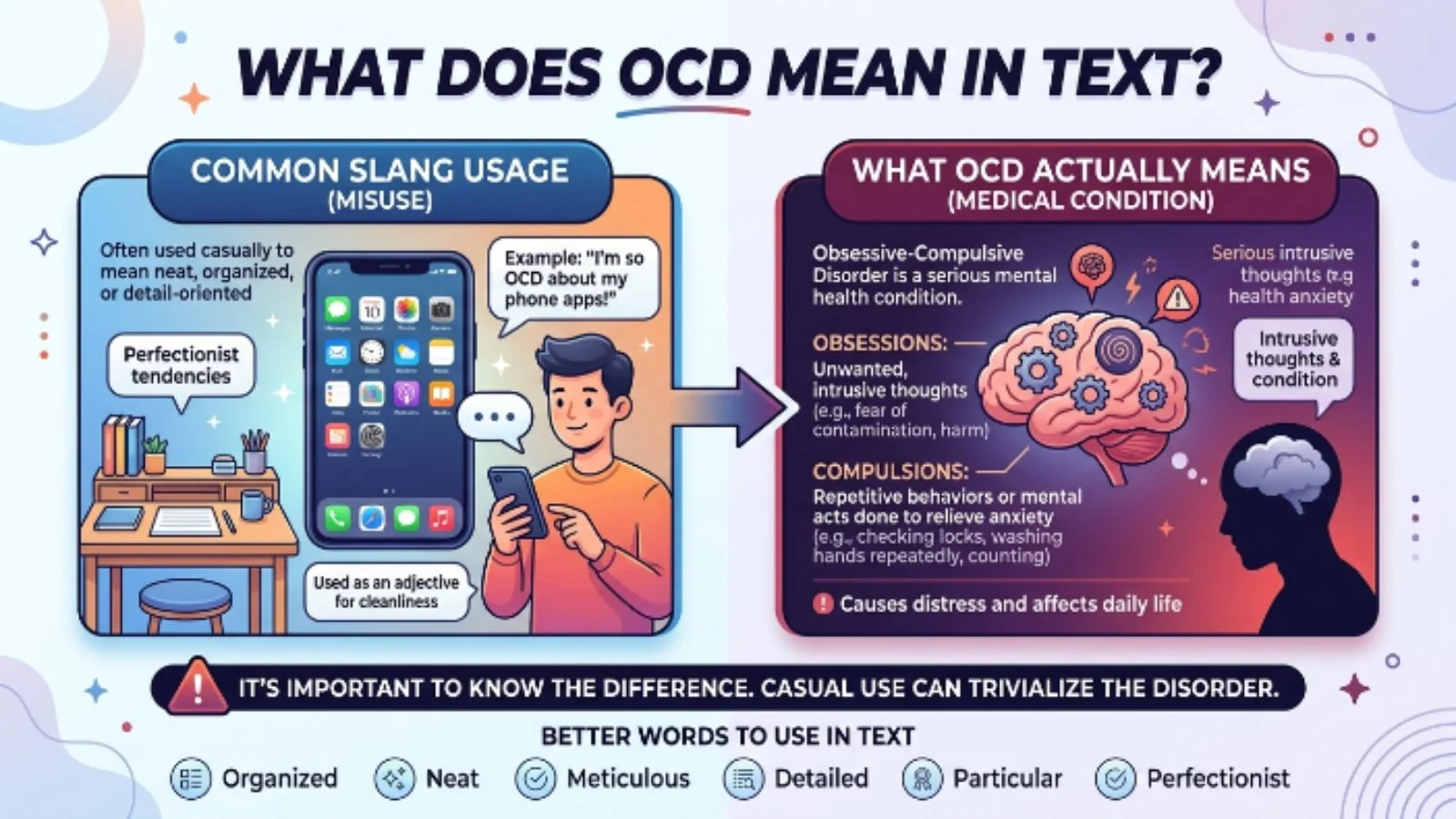
In texting, social media, and online conversations, OCD usually stands for Obsessive-Compulsive Disorder, a real mental health condition. However, many people also use the term casually to describe being very organized, neat, or particular about things.
Understanding the meaning of OCD in text is important because the abbreviation can refer to either a serious medical condition or a casual expression depending on the context.
This guide explains what OCD means in text, where the term comes from, how people use it online, common examples, misconceptions, and frequently asked questions.
What Does OCD Mean in Texting?
OCD stands for Obsessive-Compulsive Disorder.
In texting, people commonly use OCD in two ways:
- Literal meaning – Referring to the actual mental health condition.
- Casual meaning – Describing a strong preference for cleanliness, order, or perfection.
Simple Definition
When someone says “I have OCD” in a text, they may mean:
- They have been diagnosed with Obsessive-Compulsive Disorder.
- They like things arranged in a certain way.
- They feel bothered when things look messy or uneven.
The exact meaning depends on the conversation.
Quick Example
Text:
“Sorry, my OCD made me fix the spacing.”
Meaning:
The person is saying they felt compelled to correct the spacing because it bothered them.
In many cases online, people use OCD casually rather than medically.
OCD Meaning at a Glance
| Term | Meaning |
|---|---|
| OCD | Obsessive-Compulsive Disorder |
| Usage | Texting, social media, chats |
| Tone | Serious or casual |
| Common Context | Organization, perfectionism, anxiety, routines |
| Popular Since | Early internet and texting era |
The Official Meaning of OCD
Before discussing text slang, it is important to understand the real definition.
Obsessive-Compulsive Disorder (OCD) is a mental health condition involving:
- Unwanted thoughts (obsessions)
- Repeated actions (compulsions)
- Anxiety-related behaviors
- Strong urges to perform certain routines
For example:
Someone may repeatedly check if a door is locked because they fear it might be open.
This goes far beyond simply liking things clean or organized.
Key Characteristics of OCD
People with OCD may experience:
- Repetitive thoughts
- Excessive checking
- Fear of contamination
- Counting behaviors
- Repeating tasks
- Anxiety when routines are interrupted
These symptoms can affect daily life significantly.
Why Do People Use OCD in Text Messages?
The term became popular online because people started using it to describe behaviors that seem extremely organized or detail-focused.
For example:
“My books have to be lined up perfectly. I’m so OCD.”
In this sentence, the speaker may not actually have the disorder.
Instead, they are saying they are very particular about organization.
This casual usage became common on:
- Text messages
- Instagram comments
- TikTok captions
- Facebook posts
- Snapchat messages
- Online forums
- Group chats
Origin and History of OCD
Medical Origins
The term Obsessive-Compulsive Disorder has existed in psychology and medicine for many decades.
Mental health professionals began studying obsessive thoughts and compulsive behaviors long before the internet existed.
Rise in Popular Culture
During the 1990s and 2000s, awareness of OCD increased through:
- Television shows
- Movies
- News reports
- Mental health campaigns
As internet communication grew, people began shortening phrases into abbreviations.
OCD became a commonly recognized acronym.
Social Media Influence
By the 2010s and 2020s, social media users frequently used OCD informally.
Instead of referring to the actual disorder, many people used it to describe:
- Perfectionism
- Tidiness
- Attention to detail
- Neatness
This trend continues into 2026.
What Does OCD Mean on Social Media?
On social media, OCD often means:
- Being organized
- Wanting things symmetrical
- Liking perfection
- Fixing small details
Example
Post:
“I had to rearrange those pictures. My OCD couldn’t handle it.”
Meaning:
The person felt uncomfortable with the arrangement and wanted it corrected.
Another Example
Comment:
“The uneven tiles are triggering my OCD.”
Meaning:
The commenter is saying the uneven design bothers them.
In casual online language, OCD is often used humorously or exaggeratively.
Real-Life Text Examples
Here are common examples you may see.
Example 1
Friend:
“I spent an hour organizing my desk.”
Reply:
“Your OCD is showing again.”
Explanation:
The speaker is joking about their friend’s love of organization.
Example 2
Text:
“I checked the stove five times before leaving.”
Meaning:
This could refer to actual OCD symptoms.
Explanation:
Repeated checking is often associated with OCD behaviors.
Example 3
Text:
“I couldn’t sleep until all the pillows matched.”
Meaning:
The person wanted everything arranged perfectly.
Explanation:
They are describing discomfort with disorder.
Example 4
Text:
“My folders are color-coded because I’m OCD.”
Meaning:
The person likes things highly organized.
Explanation:
The term is being used casually.
Example 5
Text:
“My therapist helped me manage my OCD.”
Meaning:
This refers to the actual medical condition.
Explanation:
The context shows a serious discussion about mental health.
Short Dialogues Using OCD
Dialogue 1
Alex: Why are you reorganizing the shelf again?
Sam: My OCD hates uneven spacing.
Explanation:
Sam is saying the arrangement bothers them.
Dialogue 2
Emma: Did you lock the door?
Ryan: I checked it three times already.
Emma: Is that your OCD acting up?
Explanation:
The conversation refers to obsessive checking.
Dialogue 3
Jake: Your room looks perfect.
Mia: I know. My OCD won’t let it stay messy.
Explanation:
Mia is describing a preference for neatness.
Dialogue 4
Chris: Why did you redo the presentation?
Lily: The formatting wasn’t consistent.
Chris: That’s peak OCD.
Explanation:
Chris means Lily pays close attention to details.
Personality Traits Often Associated With OCD
Many people associate OCD with certain personality traits.
However, these traits do not automatically mean someone has OCD.
Commonly Associated Traits
- Organized
- Detail-oriented
- Careful
- Precise
- Methodical
- Perfectionistic
- Structured
Important Note
A person can be:
- Neat
- Organized
- Detail-focused
without having Obsessive-Compulsive Disorder.
This distinction is important.
Different Contexts Where OCD Is Used
1. Medical Context
Example:
“I was diagnosed with OCD last year.”
Meaning:
The speaker is discussing the actual condition.
2. Casual Context
Example:
“My OCD won’t let me leave the books uneven.”
Meaning:
The speaker means they prefer order.
3. Humor Context
Example:
“This crooked sign is hurting my OCD.”
Meaning:
The person is joking about their discomfort with the sign.
4. Workplace Context
Example:
“Her OCD-level attention to detail is impressive.”
Meaning:
The person is highly detail-oriented.
Common Situations Where People Say OCD
People often use the term when talking about:
Organization
- Arranging books
- Cleaning desks
- Sorting files
Symmetry
- Straight lines
- Matching colors
- Equal spacing
Perfection
- Editing documents
- Fixing mistakes
- Reviewing work repeatedly
Cleanliness
- Washing surfaces
- Organizing rooms
- Maintaining order
Modern Examples of OCD Usage in 2026
The way people use OCD online continues to evolve.
TikTok Example
“My OCD made me reorganize my entire closet at 2 a.m.”
Explanation:
The creator is talking about a strong desire for organization.
Instagram Example
“Swipe to see how I fixed this OCD nightmare.”
Explanation:
The post shows a messy space becoming organized.
Gaming Example
“I need all my inventory slots sorted. OCD problems.”
Explanation:
The player likes things arranged neatly.
Study Example
“My notes have to match color themes or my OCD gets annoyed.”
Explanation:
The student prefers visual organization.
Common Mistakes About OCD
Many misconceptions exist.
Mistake 1: OCD Means Being Neat
Not necessarily.
Many people with OCD struggle with intrusive thoughts and compulsions that have nothing to do with cleanliness.
Mistake 2: Everyone Has OCD
This is false.
Liking organization does not mean someone has OCD.
Mistake 3: OCD Is a Personality Type
OCD is a medical condition, not a personality trait.
Mistake 4: OCD Is Always About Cleaning
Many OCD symptoms involve:
- Checking
- Counting
- Repeating
- Mental rituals
Cleaning is only one possible symptom.
Mistake 5: OCD Is Just Perfectionism
Perfectionism and OCD are not the same thing.
Someone can be a perfectionist without having OCD.
OCD vs Perfectionism
| OCD | Perfectionism |
|---|---|
| Mental health condition | Personality tendency |
| Involves obsessions and compulsions | Focuses on high standards |
| Can cause distress | May not cause distress |
| Requires proper diagnosis | Does not require diagnosis |
| Often affects daily life | Usually manageable |
Understanding this difference helps prevent misunderstandings.
Alternative Meanings of OCD in Text
Although uncommon, OCD can occasionally have other meanings depending on the group or industry.
Examples include:
- Organizational abbreviations
- Business terms
- Internal company codes
However, in most text messages, OCD almost always means Obsessive-Compulsive Disorder.
When Should You Avoid Using OCD Casually?
Many people encourage careful use of the term because OCD is a real mental health condition.
Avoid using it casually when:
- Discussing mental health seriously
- Talking with someone diagnosed with OCD
- Referring to medical experiences
- Making fun of symptoms
Being respectful helps reduce misunderstandings.
Signs the Person Means the Real Disorder
Look for clues such as:
- Mentioning therapy
- Mentioning diagnosis
- Discussing treatment
- Talking about anxiety
- Describing intrusive thoughts
Example
“I started medication for my OCD.”
This clearly refers to the actual condition.
Signs the Person Is Using OCD Casually
Look for phrases like:
- “My OCD likes things neat.”
- “My OCD hates crooked pictures.”
- “My OCD wants everything color-coded.”
These usually refer to organization preferences rather than a diagnosis.
How to Respond When Someone Says OCD in a Text
Casual Usage
Text:
“My OCD can’t handle that messy shelf.”
Possible reply:
“Yeah, it would bother me too.”
Medical Usage
Text:
“My OCD has been difficult lately.”
Possible reply:
“I hope things get easier. Take care of yourself.”
The response should match the context.
Is OCD Positive or Negative in Text?
It depends on how it is used.
Positive Usage
Sometimes people use OCD to compliment:
- Organization
- Attention to detail
- Precision
Negative Usage
Sometimes it refers to:
- Stress
- Anxiety
- Compulsive behaviors
- Frustration
The tone depends entirely on the conversation.
Quick Summary Table
| Question | Answer |
|---|---|
| What does OCD mean in text? | Obsessive-Compulsive Disorder |
| Is it always medical? | No |
| Can it mean being organized? | Yes, in casual usage |
| Is OCD a real disorder? | Yes |
| Is perfectionism the same as OCD? | No |
| Is the term common online? | Very common |
Frequently Asked Questions
What does OCD mean in a text message?
OCD usually means Obsessive-Compulsive Disorder. In casual texting, it may also describe someone who likes things organized or orderly.
Does OCD always refer to a mental health condition?
No. Many people use it informally to describe neatness or perfectionism. However, the official meaning remains a medical condition.
Is it wrong to say “I’m OCD”?
Many mental health advocates recommend saying “I have OCD” only when referring to the diagnosed condition. Casual use can sometimes create misunderstandings.
What is the difference between OCD and being organized?
Being organized is a preference. OCD involves intrusive thoughts, compulsions, and significant distress that can affect daily life.
Why do people use OCD as slang?
People often use it to describe a strong need for order, symmetry, cleanliness, or perfection in everyday situations.
Is OCD common on social media?
Yes. The term frequently appears in TikTok videos, Instagram captions, memes, comments, and text conversations.
How can I tell if someone means the real disorder?
Look at the context. Mentions of therapy, diagnosis, medication, anxiety, or treatment usually indicate the actual medical condition.
Conclusion
Understanding what OCD means in text is important because the abbreviation can have both a medical and a casual meaning. Officially, OCD stands for Obsessive-Compulsive Disorder, a real mental health condition involving obsessions and compulsions. In everyday texting and social media conversations, people often use OCD to describe being highly organized, detail-oriented, or bothered by disorder. The key is paying attention to context. When someone mentions diagnosis, treatment, or symptoms, they are likely referring to the actual condition. When discussing neatness or perfectionism, the term is often being used informally. Knowing the difference helps you communicate more accurately and respectfully in modern digital conversations.