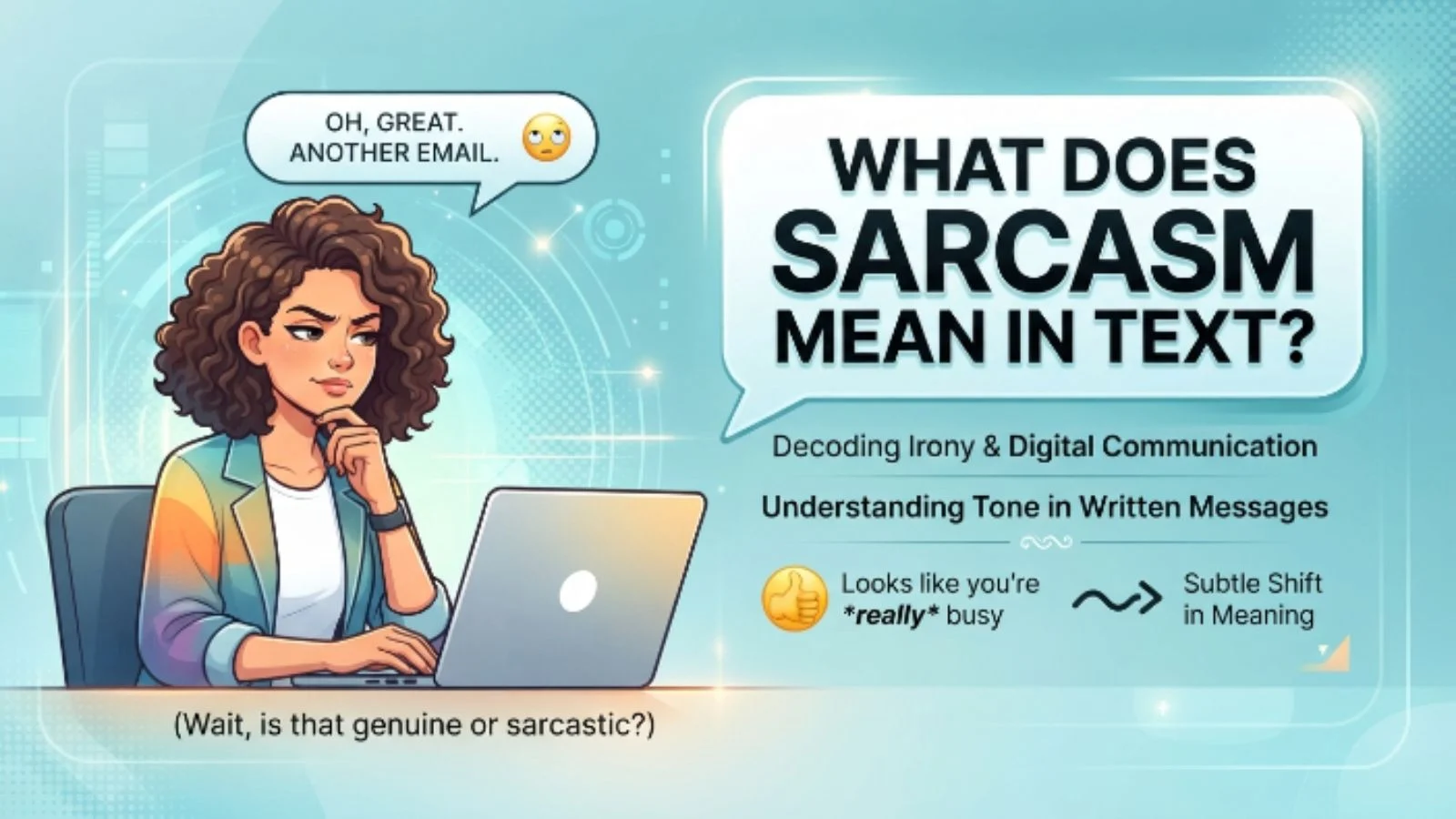
Have you ever opened a text message, read it three times, and felt your stomach drop? You can’t tell if your friend is genuinely happy for you or low-key throwing shade. Your boss sends a message saying, “Great job on the presentation,” but there is no punctuation, no context, and definitely no smiling emoji. Suddenly, you are spiraling.
Texting has changed the way we communicate, but it has also stripped away our most important tools: tone of voice, facial expressions, and body language. Without those clues, reading a text can feel like trying to decode a secret message in the dark.
This brings us to one of the biggest digital communication headaches of our time: digital irony. If you have ever felt lost trying to figure out if someone is being serious or just playing with you, this guide is for you.
What Does Sarcasm Mean in Text?
To put it simply, sarcasm in text means using words that say the exact opposite of what you actually mean, usually to be funny, make a point, or mock a situation.
When we speak face-to-face, we use a specific tone—like dropping our pitch or drawing out our words—to signal that we are joking. In a text message, however, those physical cues vanish.
Featured Snippet Definition: Sarcasm in text refers to the intentional use of words that convey the opposite of their literal meaning, typically adapted for digital screens through formatting, punctuation, or emojis. Because digital text lacks tone of voice, online writers rely on specific context clues to prevent misunderstandings.
When someone uses textual irony, they expect you to look past the literal definition of the words and read between the lines to find their true intent.
The Simple Meaning of Digital Sarcasm
Think of digital sarcasm as an “insider joke” between the sender and the receiver. If you ask a friend how their rainy, cold vacation is going and they text back, “Oh, it is absolutely beautiful out here,” they do not actually think the storm is lovely. They are using irony to highlight how miserable the weather is.
The challenge is that text messages flatten our speech. If you don’t know the sender’s personality well, a sarcastic remark can easily look like a mean comment, a weird insult, or a genuine compliment. It requires both people to be on the exact same page.
Where Is It Used Most Often?
You will find people rewriting the rules of language across almost every digital platform. However, the style changes depending on where you are typing.
1. Group Chats and Private DMs
On apps like WhatsApp, iMessage, and Messenger, irony is deeply personal. It relies heavily on your existing relationship with the person. Close friends will often use extreme exaggeration or hyperbole because they already know each other’s sense of humor.
2. Social Media Platforms
On platforms like X (formerly Twitter), TikTok, and Reddit, sarcasm is practically a native language. Because users are writing for a broader, public audience, they use highly standardized digital slang and formatting hacks to make sure their joke does not backfire.
3. Workplace Communication
Using it on Slack or Microsoft Teams is a massive gamble. Because professional platforms require clarity, trying to use irony with a coworker or manager often leads to awkward follow-up meetings or accidental offenses.
Why Do People Use Sarcasm in Text?
Why do we keep using a communication style that causes so many misunderstandings? Humans are naturally wired to seek connection and nuance, even through a glowing screen.
- To Soften a Bad Situation: Laughing at a terrible day makes it easier to handle. Texting “Living the dream” while stuck at the airport for six hours is a way to bond over shared frustration.
- To Create Intimacy: Inside jokes and shared irony create a sense of belonging. When you understand a friend’s subtle digital tone, it proves how well you know them.
- To Avoid Being Overly Dramatic: Sometimes, saying exactly how upset you are feels too heavy. A sharp, ironic comment lets someone vent without bringing down the mood of the conversation.
Real-Life Examples and How to Read Them
Let’s look at how the exact same phrase changes meaning depending on how it is formatted and delivered.
Example 1: The Literal Compliment vs. The Sarcastic Retort
- The Context: You accidentally drop your phone into a cup of coffee.
- The Text: “Wow, you are an absolute genius.”
- The Explanation: Literally, they are calling you smart. In reality, they are pointing out a clumsy mistake. The context of the ruined phone tells you everything you need to know.
Example 2: The “SpongeBob” Mocking Text
- The Text: “yOu NeEd To StArT sAvInG mOnEy.”
- The Explanation: Alternating between uppercase and lowercase letters is a universal internet rule. It indicates that the sender is repeating something someone else said in a whining, mocking voice.
Example 3: The Overuse of Periods
- The Text: “That sounds so fun.”
- The Explanation: While a period is grammatically correct, putting a single period at the end of a short, enthusiastic phrase online often signals a flat, deadpan delivery. It actually means, “That sounds incredibly boring.”
Sarcasm vs. Similar Digital Terms
It is easy to confuse sarcasm with other types of internet humor. Let’s break down the differences so you can recognize them instantly.
| Term | What It Actually Means | How It Looks in a Text |
| Sarcasm | Saying the opposite of what you mean to mock or be funny. | “I love working on Saturdays.” |
| Satire | Using humor or irony to criticize someone’s stupidity or political views. | A fake news headline mocking public transit delays. |
| Cynicism | Believing that people are motivated purely by self-interest. | “They only texted you back because they want something.” |
| Facetiousness | Treating serious issues with deliberate, inappropriate humor. | Making a light joke immediately after someone dents their brand-new car. |
When Should You Use It (And When to Avoid It)?
Using textual irony safely requires a lot of emotional intelligence. It is all about timing and knowing your audience.
✅ When It Is Safe to Use
- With close friends and family: People who can hear your actual voice inside their head when they read your texts.
- When accompanied by clear signals: If you use indicators like standard abbreviations or specific punctuation to clarify your intent.
- For self-deprecating humor: Making fun of yourself is usually safe because it does not risk hurting anyone else’s feelings.
⚠️ When to Completely Avoid It
- With new acquaintances: If someone does not know your real-world personality, they will almost always read your text literally.
- In professional emails: A client or boss reading a sarcastic line can easily view it as passive-aggressive behavior or unprofessionalism.
- During a serious argument: Trying to use irony when someone is already upset is like throwing gasoline on a fire. Stick to direct, honest words.
Common Misunderstandings in Digital Text
The biggest issue with text-based irony is negative bias. Psychologists have found that when people read a text message with an ambiguous tone, their brains automatically default to assuming the message is negative, cold, or angry.
If you text your partner “Fine” or “Sure,” you might mean it cheerfully. But to them, those single words look short, blunt, and hostile. The lack of vocal inflection causes the human brain to fill in the blanks with its worst insecurities. This is exactly why digital communication requires extra effort to keep things clear.
Pro Tips: How to Signal Sarcasm in Text Safely
If you want to use irony without causing a massive argument, the internet has created a few brilliant formatting workarounds.
- The /s Tag: Borrowed from computer coding, adding a simple
/sto the very end of your sentence tells the reader that everything before it was sarcastic. - The Toggling Case: As shown earlier, typing like
tHiStells the reader to read the sentence in a goofy, sarcastic tone. - Extreme Exaggeration: Make your statement so completely wild that no one could possibly believe you are being serious. For example: “I have waiting in this grocery line for approximately three hundred years.”
- The Deadpan Description: Writing out an action in brackets, such as
*gasp*or*shocker*, helps set the stage for your joke.
Final Thoughts
At the end of the day, understanding what sarcasm means in text comes down to context and connection. The internet is a fantastic tool for staying touch, but it is a terrible tool for conveying subtle human emotions.
If you are ever in doubt about a message you received, do not spend hours overanalyzing it with your friends. Simply ask for clarification, or better yet, pick up the phone and call them. A two-second conversation can save you from days of useless worrying.
Frequently Asked Questions
Is sarcasm hard to understand in text?
Yes, it is incredibly difficult. Because written text completely removes vocal tone, facial expressions, and body language, readers naturally struggle to identify irony. The human brain often interprets ambiguous texts as negative or aggressive.
What does /s mean at the end of a text?
The /s symbol is a universal internet tone indicator that stands for sarcasm. It is placed at the end of a message to explicitly let the reader know that the statement should not be taken literally.
How do you reply to a sarcastic text?
If the joke is lighthearted, you can play along by escalating the exaggeration or using a sarcastic tone indicator of your own. If the text felt hurtful or confusing, it is best to reply directly and ask, “Are you being serious, or just joking?”
Why do people sound passive-aggressive when texting?
This usually happens because short sentences and standard punctuation look incredibly formal and cold on a phone screen. A simple period at the end of a short sentence like “Okay.” can make a perfectly friendly message sound harsh and angry.