Have you ever received a message that made you pause and think, “Are they serious… or joking?”
Maybe someone texted:
“Wow. That was just perfect.”
But you knew it was not perfect at all.
That is called being sarcastic.
In this complete guide, you will learn:
- The simple meaning of sarcastic in text
- Where the word came from
- How sarcasm works in messages
- Real-life examples with easy explanations
- Personality traits linked to sarcasm
- Common mistakes
- Modern 2026 texting trends
- FAQs people really ask
Everything is written in simple English so anyone can understand.
Let’s begin.
What Does Sarcastic Mean in Text? (Simple Definition)
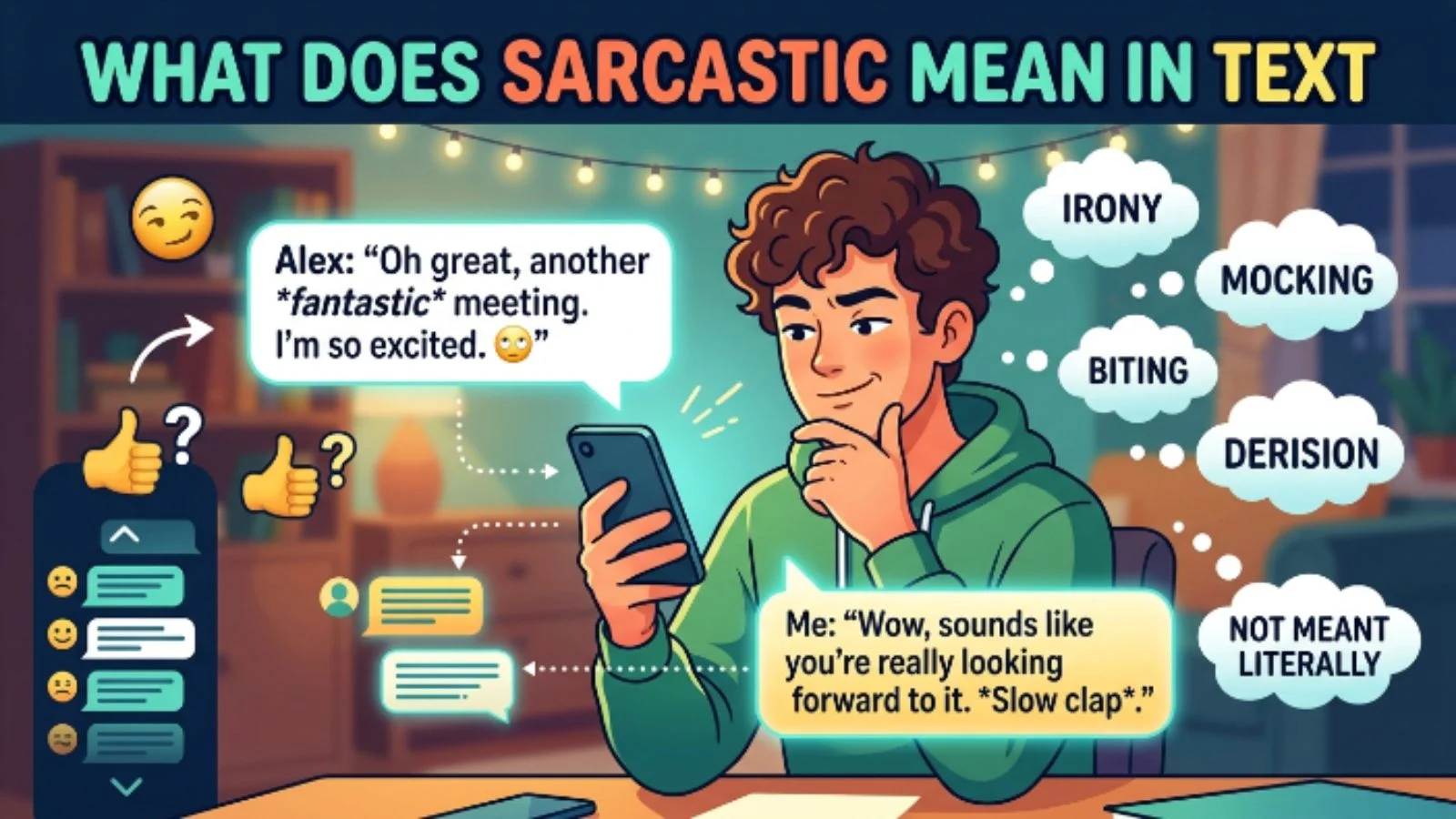
Sarcastic means saying something that sounds positive but actually means the opposite.
It is often used to:
- Make fun of something
- Show annoyance
- Express anger in a funny way
- Joke in a sharp way
In text messages, sarcasm can be hard to understand because you cannot hear the voice tone.
Simple Meaning in One Line
Sarcastic in text means saying the opposite of what you really mean, often to be funny or rude.
What Is Sarcasm?
Sarcasm is the style of speaking or writing that uses ironic or opposite words.
If someone says:
“Great job!”
But you clearly failed — that is sarcasm.
They do not really mean “great.”
They mean the opposite.
Origin and History of the Word “Sarcastic”
The word sarcastic comes from the Greek word sarkazein.
That word means:
“To tear flesh.”
Yes, it sounds harsh.
Later, it became part of Latin and then English. Over time, the meaning changed to:
- Sharp speech
- Cutting words
- Mocking tone
The word became common in English around the 16th century.
Why such a strong origin?
Because sarcasm can “hurt” like sharp words.
Even today in 2026, sarcasm still has that sharp feeling.
Why Do People Use Sarcasm in Text?
People use sarcasm for many reasons.
Here are common ones:
1. To Be Funny
Some people use sarcasm as humor.
Example:
“You’re only 30 minutes late. Impressive.”
Meaning: You are very late.
Explanation: The word “impressive” is not real praise. It is joking criticism.
2. To Show Annoyance
Instead of saying “I am angry,” people use sarcasm.
Example:
“Oh yes, ignore my message. That’s cool.”
Meaning: I am upset you ignored me.
Explanation: “That’s cool” does not mean cool. It shows frustration.
3. To Sound Smart or Witty
Some people think sarcasm makes them sound clever.
Example:
“Sure, because that makes total sense.”
Meaning: That makes no sense.
Explanation: The sentence sounds logical but actually criticizes.
4. To Hide Real Feelings
Sarcasm can hide pain.
Example:
“Yeah, I totally wanted that to happen.”
Meaning: I did not want that at all.
Explanation: The person is upset but uses sarcasm instead of direct words.
How Sarcasm Looks in Text Messages (2026 Style)
In text, tone is missing. So people add signals.
Here are common ways sarcasm appears in 2026:
| Text Style | Example | What It Means |
|---|---|---|
| All caps | “WOW. AMAZING.” | Not amazing at all |
| Period after short word | “Sure.” | Probably annoyed |
| Extra letters | “Suuure.” | Doubt or mockery |
| Quotation marks | “Great idea.” | Not actually great |
| Dry response | “Nice.” | Not impressed |
Explanation: These writing styles help show sarcasm since voice tone is missing.
Real-Life Examples with Short Dialogues
Example 1: Late Friend
A: “Sorry I’m two hours late.”
B: “Oh wow, right on time.”
Meaning: You are very late.
Explanation: “Right on time” means the opposite here.
Example 2: Bad Cooking
A: “How’s the food?”
B: “Best meal of my life.”
Meaning: The food is bad.
Explanation: The extreme praise shows sarcasm.
Example 3: Rainy Day
A: “It’s raining on our picnic.”
B: “Perfect weather.”
Meaning: This weather is terrible.
Explanation: “Perfect” is used ironically.
Example 4: Failing Test
A: “I got 20 out of 100.”
B: “Wow, genius.”
Meaning: That score is very low.
Explanation: “Genius” is used to tease.
Example 5: Slow Internet
A: “The page won’t load.”
B: “Love this fast internet.”
Meaning: The internet is slow.
Explanation: The word “fast” is opposite of reality.
Sarcastic Personality Traits
Not everyone uses sarcasm the same way.
People who use sarcasm often have these traits:
- Quick thinkers
- Good at humor
- Emotionally guarded
- Sometimes passive-aggressive
- Observant
But remember:
Sarcasm does not always mean someone is mean.
Sometimes it just means they like playful humor.
When Sarcasm Is Friendly vs. Rude
Sarcasm can feel different depending on tone and relationship.
Friendly Sarcasm
Used between close friends.
Example:
“Nice driving, race car driver.”
Meaning: You made a small mistake.
Explanation: It is playful, not serious.
Rude Sarcasm
Used to insult or embarrass.
Example:
“You’re so smart.”
Meaning: You made a foolish mistake.
Explanation: It feels hurtful.
Common Misconceptions About Sarcasm
Many people misunderstand sarcasm.
Here are common myths:
1. Sarcasm Is Always Funny
No. It can hurt feelings.
2. Sarcasm Is the Same as Lying
No. It is saying the opposite clearly, often for effect.
3. Sarcasm Is the Same as Irony
Not exactly.
Irony is when something unexpected happens.
Sarcasm is when someone says the opposite on purpose.
4. Everyone Understands Sarcasm
Not true.
Some people:
- Take words literally
- Miss tone in text
- Have cultural differences
That is why sarcasm in text can cause confusion.
How to Tell If Someone Is Being Sarcastic in Text
Look for clues.
Clue 1: The Situation
Does the sentence match reality?
If not, it may be sarcasm.
Clue 2: Extreme Praise
“Best day ever.”
When the day was clearly bad.
Clue 3: Dry Short Replies
“Nice.”
Could mean the opposite.
Clue 4: Your Relationship
Close friends use sarcasm more.
Modern Sarcasm Trends in 2026
Sarcasm keeps changing with digital culture.
Here are new patterns seen in 2026:
1. Deadpan Texting
Very flat tone.
Example:
“Thrilled.”
Meaning: Not thrilled at all.
Explanation: The short word shows boredom.
2. Minimal Response Sarcasm
“Cool.”
Often means not cool.
3. Fake Positivity
“Living the dream.”
Meaning: Things are stressful.
4. Corporate Sarcasm
Seen in work chats.
“Per my last email.”
Meaning: I already told you.
Explanation: It sounds polite but shows frustration.
When NOT to Use Sarcasm in Text
Avoid sarcasm:
- In professional emails
- With people who do not know you well
- During serious conversations
- When someone is sad
Why?
Because text has no tone. It can easily be misunderstood.
Simple Comparison Table: Direct vs Sarcastic
| Situation | Direct Message | Sarcastic Message |
|---|---|---|
| Friend late | “You’re late.” | “Right on time.” |
| Bad weather | “This weather is bad.” | “Perfect weather.” |
| Low score | “That score is low.” | “Wow, genius.” |
| Slow service | “This is slow.” | “So fast.” |
Explanation: Sarcasm uses opposite words to show meaning.
Is Sarcasm Good or Bad?
It depends.
Good Side
- Funny
- Creative
- Shows intelligence
- Makes conversations lively
Bad Side
- Can hurt feelings
- Causes misunderstandings
- May seem rude
- Not always clear in text
Balance is important.
Psychological View: Why the Brain Uses Sarcasm
Research shows sarcasm needs:
- Social awareness
- Emotional intelligence
- Understanding of context
The brain must:
- Hear the sentence
- Notice it does not match reality
- Understand hidden meaning
That is why children and some adults struggle with sarcasm.
Cultural Differences in Sarcasm
In some cultures:
- Sarcasm is common and playful.
In others:
- It may seem disrespectful.
In online global chats (like in 2026 social apps), sarcasm can easily confuse people from different backgrounds.
Always think before using it.
How to Use Sarcasm Safely in Text
If you want to use sarcasm:
- Use it with close friends
- Make sure context is clear
- Avoid serious topics
- Do not overuse it
Too much sarcasm can make you seem negative.
Signs Someone Is NOT Being Sarcastic
Sometimes people think sarcasm is there when it is not.
If someone:
- Explains clearly
- Uses simple direct language
- Gives details
They are likely serious.
Do not assume sarcasm too quickly.
Quick Summary in Simple Words
Sarcastic in text means saying the opposite of what you mean, usually to joke or show annoyance.
It can be funny.
It can also hurt.
Understanding context is key.
FAQs About “What Does Sarcastic Mean in Text?”
1. What does sarcastic mean in texting?
It means saying the opposite of what you really feel, often to be funny or critical.
2. How can I tell if someone is sarcastic in text?
Look at the situation. If their words do not match reality, it may be sarcasm.
3. Is sarcasm rude?
It can be rude if used to insult. It can be friendly if used playfully.
4. Why is sarcasm hard to understand in text?
Because you cannot hear voice tone or see facial expressions.
5. Is sarcasm the same as irony?
No. Irony is about unexpected situations. Sarcasm is a sharp way of speaking.
6. Do smart people use sarcasm more?
Some studies suggest sarcastic humor needs quick thinking. But anyone can use sarcasm.
7. Should I use sarcasm in professional messages?
It is better not to. It may be misunderstood and seem disrespectful.
Final Thoughts: Understanding Sarcastic Meaning in Text
Sarcasm is powerful. It is creative. It is sharp.
When someone is sarcastic in text, they usually say the opposite of what they mean. Sometimes it is funny. Sometimes it hides frustration. Sometimes it protects feelings.
In 2026 digital communication, sarcasm is common in chats, social media, and group messages. But because tone is missing, misunderstandings happen easily.
The best advice?
Use sarcasm carefully. Understand context. Know your audience.
And if you are unsure whether someone is sarcastic — ask kindly.
Clear communication is always stronger than clever confusion.
If you found this guide helpful, consider sharing it with someone who often says “Wow, great job” when things go wrong.