Have you ever looked at your phone and seen a message that just says SOS? If you do not know what it means, it can feel a bit scary. You might ask yourself if your friend is in real danger. Or maybe they are just having a dramatic moment.
Today, people use this short term in many different ways. It can show up in family group chats, funny messages from friends, or even at the top of your cell phone screen.
This detailed guide will explain everything you need to know about this term. We will look at its clear meaning, its history, how people use it today, and the common mistakes you should avoid.
The Clear Meaning of SOS in Simple Words
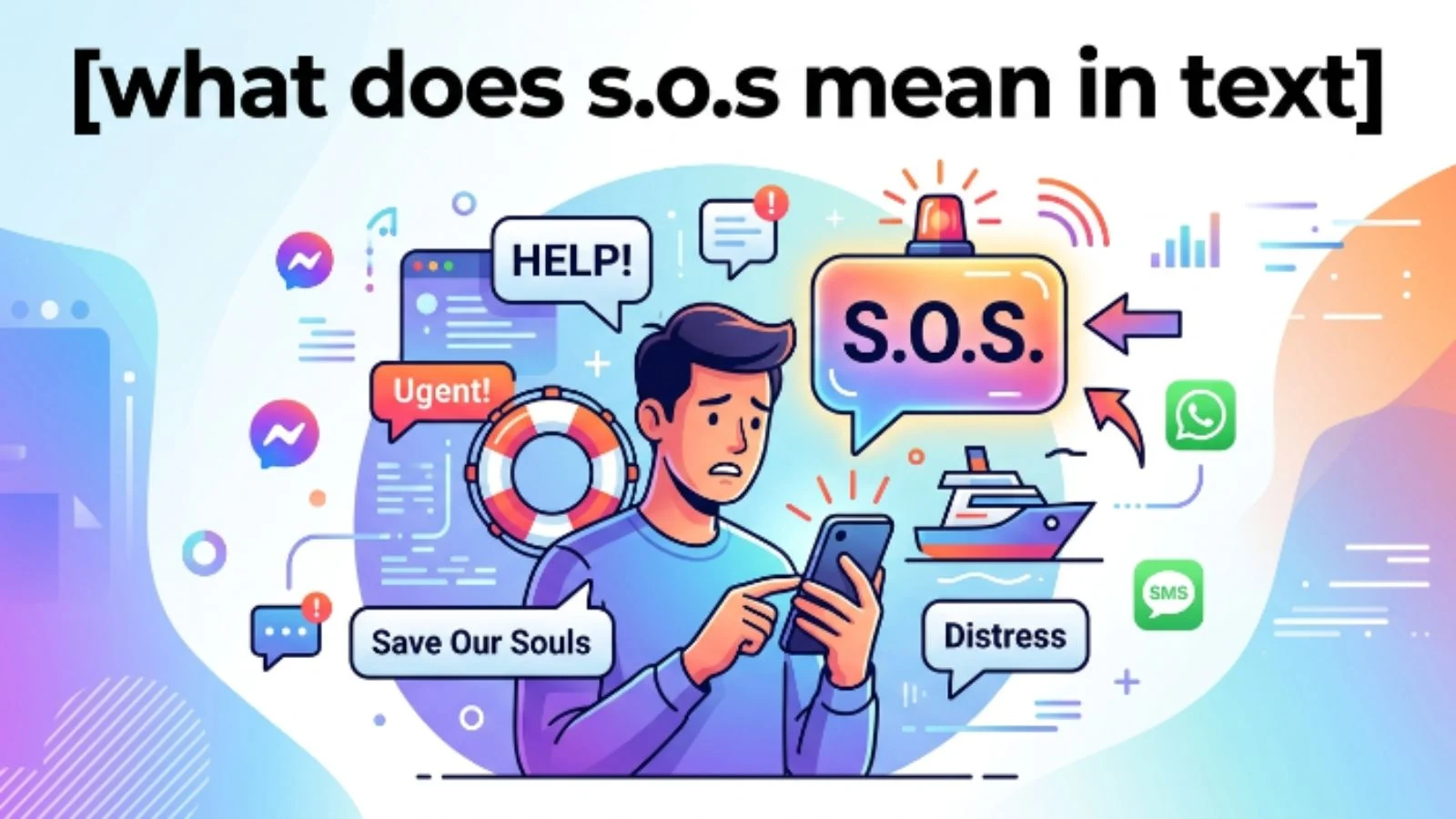
In short, SOS means help. When someone sends this in a text message, they are usually saying that they need fast assistance or that they are facing a stressful situation.
However, the exact feeling behind the message depends on who is sending it. In modern text messages, the term usually falls into two categories:
- A Real Emergency: The person is in actual trouble and needs you to help them right away.
- A Small or Funny Problem: The person is exaggerating a minor inconvenience because they feel overwhelmed or annoyed.
Simple Definition: SOS is a short way to say “Help me right now.” People use it in text messages when they are stuck, stressed, or need immediate assistance with a problem.
The True Origin and History of SOS
Many people believe that SOS is an acronym. An acronym is a word formed from the first letters of other words. You might have heard that it stands for Save Our Ship or Save Our Souls.
But as a matter of historical fact, SOS does not stand for anything at all. It is not an abbreviation.
The Morse Code Connection
The signal was created more than one hundred years ago for Morse code. Morse code is a system that uses short and long bursts of sound or light to send messages. In this system, dots represent short sounds, and dashes represent long sounds.
The code for SOS is very easy to remember and recognize:
$$\text{Three Short (}\cdot \cdot \cdot\text{) } + \text{ Three Long (}— \text{) } + \text{ Three Short (}\cdot \cdot \cdot\text{)}$$
Because this pattern of three dots, three dashes, and three dots is so distinct, the International Radio Telegraphic Convention adopted it as the official international distress signal in the early twentieth century. It was designed so that wireless operators on ships could send a fast alert when they were in deep danger at sea. Over time, people began to spell out the letters out loud as S-O-S, and the phrase entered everyday language as a universal cry for help.
Real-Life Examples and Short Dialogues
To help you understand how this term looks in daily life, let us review some common text scenarios. We will provide a brief breakdown for each example so you can see exactly how the meaning shifts.
Scenario 1: A Small, Drama-Filled Problem
In this conversation, a teen is using the word to show that they are bored or slightly annoyed.
- Friend A: What are you doing right now?
- Friend B: Sitting through this long family dinner. SOS please save me.
Explanation for beginners: Friend B is not in physical danger. They are just bored and want their friend to text them so they have a distraction.
Scenario 2: A Real Request for Urgent Help
In this conversation, a family member needs actual assistance with a daily problem.
- Dad: Hey, I am at the grocery store but I forgot the shopping list. SOS!
- Mom: I will photo it and send it to you right now.
Explanation for beginners: Dad uses the term to show he is stuck at the store and cannot move forward without quick help from home.
Scenario 3: Secret Text Slang (Someone Over Shoulder)
Sometimes, younger users employ these letters to mean something completely different: Someone Over Shoulder. This warns the other person to change the topic.
- Sam: Did you see what happened at school today?
- Alex: SOS talk later.
- Sam: Oh got it, tell me later.
Explanation for beginners: Alex is telling Sam that a parent or teacher is standing close by and looking at the screen, so it is not safe to chat freely.
Usage Context and Personality Traits
The way someone uses SOS can tell you a lot about their current mood, text style, and level of stress. Let us analyze how different types of people use this term in text messages.
| Type of Sender | How They Use It | What It Teaches Us |
| The Dramatic Friend | Uses it for tiny issues like a bad haircut or a boring movie. | They love to exaggerate and want immediate attention or a laugh. |
| The Busy Parent | Uses it when they are running late or forgot something crucial. | They are genuinely overwhelmed by chores and need quick assistance. |
| The Quiet Person | Rarely sends it, but uses it when something is genuinely wrong. | You should take their message seriously and reply as fast as possible. |
Common Mistakes and Misconceptions
Because this phrase has been around for such a long time, many people get confused about its rules and meanings. Here are the most common errors people make.
- Thinking it always means a life-or-death emergency: While it can mean a real emergency, ninety percent of the time in casual chat, it is just a joke about being bored or tired. Look at the context before you panic.
- Writing it with periods after every letter: In modern text slang, writing S.O.S. looks too formal and slow. Most people just type SOS or even lowercase sos to keep it moving fast.
- Confusing it with other internet slang: Do not confuse it with terms like LOL (laugh out loud) or BRB (be right back). This term is specifically reserved for moments when someone needs an exit strategy or a helping hand.
Modern and Relatable Examples
As we navigate through the digital space, technology has given this classic term some brand-new meanings. Here is how you will experience it today.
The Smartphone Safety Feature
If you look at the top corner of your mobile phone when you lose cellular service, you might see the words SOS Only. This is a built-in safety setting. It means your phone cannot make regular calls or send standard text messages because you have a weak network connection.
However, your phone can still connect to other nearby networks to place an emergency call to local authorities if you are in danger.
The Quick Rescue Request
Imagine you are on a terrible blind date, and the other person will not stop talking about themselves. You might text your best friend:
“This date is going terribly. SOS please call me with a fake emergency.”
This shows how the term acts as a fast tool to get out of uncomfortable social situations.
Frequently Asked Questions
Does SOS stand for Save Our Souls?
No. This is a popular myth called a backronym. A backronym is an explanatory phrase created after a word already exists. The letters were chosen for Morse code simply because they were easy to send and understand.
Why does my iPhone say SOS at the top?
When your iPhone displays this message, it means you do not have a standard cellular connection. You cannot send regular text messages or browse the web, but you can still make emergency phone calls.
Is texting SOS rude?
No, it is not rude. It is a very efficient way to let someone know that you need their immediate attention. Just make sure not to over-use it, or people might stop taking your requests seriously.
Can I use lowercase sos in a text?
Yes. Many people type sos in lowercase letters when they are chatting casually with close friends. Using lowercase often makes the message feel more relaxed and less like a real emergency.
What should I do if a friend texts me SOS?
First, read the messages that came before it to understand the context. If they are in a safe place but feel stressed, send a supportive reply. If you suspect they are in real danger, call them immediately to check on their safety.
Is there a difference between SOS and Mayday?
Yes. Both are calls for help, but Mayday is used specifically for voice communication over radio channels, like in aviation or boating. SOS originated as a written or typed signal in Morse code.
Conclusion
Understanding what SOS means in text messages helps you communicate better with your friends and family. Whether someone is dealing with a real emergency, facing a super boring chore, or warning you that a parent is looking over their shoulder, this three-letter phrase is a powerful tool for modern communication. Always remember to check the context of the conversation so you know how to react appropriately.
If you want to keep improving your digital communication skills and master the latest text trends, take a moment to explore our other vocabulary guides. Sign up for our free newsletter today to get expert language tips delivered straight to your inbox.