Have you ever been scrolling through an online forum, opening an old text document, or playing an imported video game only to run into a bizarre sequence of characters like >锟絫锟?
It looks like a secret spy code, a computer virus, or perhaps some highly exclusive internet slang that you are not initiated into. You might wonder if your screen is glitching, or if someone is typing in a completely different language that your device cannot load.
The truth is actually a fascinating mix of computer science history, database errors, and modern internet meme culture. If you have ever stared at >锟絫锟 in absolute confusion, you are in the right place. Let us break down exactly what this strange text means, why it appears, and how it transitioned from a technical glitch into a viral internet joke.
What Does >锟絫锟 Mean in Text?
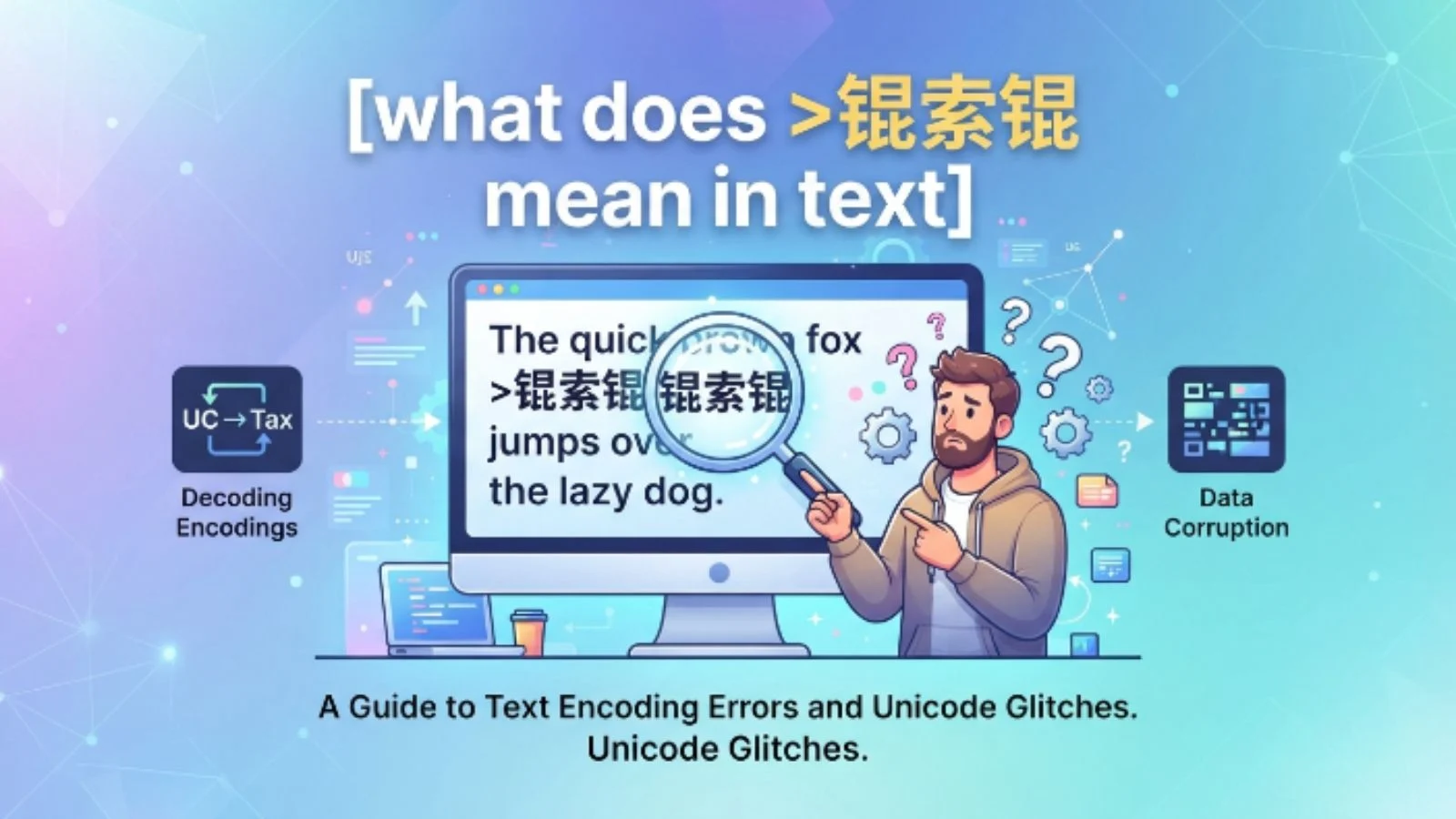
In the simplest terms, >锟絫锟 is a visual symptom of a computer encoding error known as Mojibake. It is not a real word, nor does it have a direct translation in any spoken language. Instead, it occurs when a computer program tries to read text written in one character encoding standard but mistakenly decodes it using a completely different, incompatible standard.
Specifically, this error almost always happens when modern UTF-8 encoded text (the universal standard for displaying text on the internet) is forced through an older Chinese encoding system called GBK or GB2312.
Over time, because this specific string of gibberish appeared so frequently on older web pages and game forums, internet users in East Asia began using it intentionally as internet slang. In text conversations, typing >锟絫锟 is the digital equivalent of saying:
- “My brain has short-circuited.”
- “This makes absolutely no sense.”
- “The system is broken.”
- “I am experiencing a total mental glitch.”
The Simple Meaning: Why Your Screen Is Showing This
If you do not want to get bogged down in heavy computer science jargon, think of it this way:
Imagine you write a letter in English, but the post office uses a machine that only reads French. The machine looks at your English words, tries to force them into French pronunciation rules, and prints out absolute nonsense.
That is exactly what is happening to your computer screen when you see >锟絫锟.
One system tried to say something completely normal, like an empty space, a punctuation mark, or a special character. But the receiving system did not understand the formatting, panicked, and translated those hidden data bytes into the Chinese characters 锟 (kūn) and 絫 (lěi), punctuated by broken question marks.
The Science Behind the Glitch: How >锟絫锟 is Born
To truly understand how this happens, we have to look under the hood at how computers read text. Computers do not actually understand letters or characters; they only understand numbers (bytes).
When you write text, a system called encoding translates your letters into numbers. When someone else opens your message, their system uses decoding to turn those numbers back into letters.
The glitch that creates >锟絫锟 relies on a very specific recipe involving two main players:
1. The Unicode Replacement Character
When a computer encounters a byte of data that it cannot recognize or display, it refuses to crash. Instead, it replaces that broken character with a standard placeholder called the Unicode Replacement Character, which looks like a white question mark inside a black diamond: ****.
In the universal UTF-8 encoding standard, this replacement character is represented by three specific bytes of data: EF BF BD.
2. The GBK Encoding Mismatch
GBK is a character encoding system designed to display Simplified Chinese. Unlike English, which uses one byte per letter, Chinese characters are incredibly complex and require two bytes of data to display a single character.
When a system using GBK mistakenly tries to read a string of UTF-8 replacement characters (“), it groups those three bytes (EF BF BD) into two-byte pairs:
- It takes
EFandBFand pairs them together:EF BF. In the GBK library, this exact pair of bytes represents the Chinese character 锟 (kūn). - It then takes the remaining
BDand pairs it with the first byte of the next replacement character, creating a new two-byte sequence likeBD F5. In GBK, this sequence translates to the character 絫 (lěi). - The cycle repeats, leaving single unmatched bytes to display as broken question marks (****).
When you put those mismatched pieces together, the innocent placeholder symbols suddenly transform into >锟絫锟.
Where Is This Text Error Used and Seen?
While it originated as an accidental technical error, you can now find >锟絫锟 in two very different contexts online:
1. Accidental Appearances (Technical Glitches)
- Legacy Internet Forums: Older message boards that have not updated their databases to modern UTF-8 standards.
- Imported PC Games: Video games translated from Chinese, Japanese, or Korean developers where the localizing software failed to translate the text files correctly.
- Subtitles and SRT Files: Movie or anime subtitle files downloaded online that display garbled text instead of actual dialogue.
- Database Migrations: When a company copies customer data from an old legacy server to a modern cloud server without converting the text formats.
2. Intentional Appearances (Internet Slang)
- Social Media: Users typing >锟絫锟 on platforms like Reddit, TikTok, or Weibo to mock a post that is poorly written or highly confusing.
- Gaming Chats: Players typing it into game chats when a server lag occurs, or when a teammate does something completely illogical.
- Tech Communities: Programmers using it as a humorous self-deprecating joke when their code fails to compile.
Why Do People Use It Intentionally?
In the early days of the internet, seeing garbled text was incredibly annoying. But as internet culture evolved, communities began to find humor in these shared digital struggles.
People started using >锟絫锟 intentionally because it perfectly captures the feeling of a system failure. When someone says something so bizarre that you do not even know how to respond, typing >锟絫锟 tells them that their statement was so illogical it literally corrupted your ability to process language.
It is highly popular because it bypasses language barriers within global gaming and tech communities. It has become a badge of honor for internet-savvy users who understand the deeper technical joke behind the gibberish.
Real-Life Examples of >锟絫锟 in Conversations
To see how this works in day-to-day internet conversations, look at these hypothetical scenarios:
Scenario A: The Confusing Friend
Friend: “I think we should order a pizza with pineapple, extra mustard, chocolate chips, and hot sauce.”
You: “What does >锟絫锟 mean in text? Oh wait, that is my brain completely crashing after reading your pizza order.”
Scenario B: The Overworked Programmer
Developer 1: “Did you manage to fix the database migration issue from last night?”
Developer 2: “Not yet. I opened the user profile table and the entire database is just a wall of >锟絫锟. I think I need another cup of coffee.”
>锟絫锟 vs. Similar Encoding Memes
The “Mojibake” universe is filled with different variations of garbled text errors. Depending on what programming language or region you are dealing with, you might run into different memes.
Below is a comparison table to help you distinguish between these famous digital glitches:
| Garbled Code / Slang | Primary Cause | Cultural Meaning / How It Is Used |
| >锟絫锟 | UTF-8 replacement bytes interpreted as GBK encoding. | Represents a system glitch, mental confusion, or “brain lag.” |
| 锟斤拷 (Kun-Jin-Kao) | A very common sister variant of the same UTF-8 to GBK error. | The absolute king of Chinese encoding memes; used to represent total gibberish or garbage data. |
| 烫烫烫 (Tang-Tang-Tang) | Uninitialized memory stack bytes (0xCC in MSVC compiler) interpreted as Chinese characters. | Used by programmers to mock memory allocation errors or running out of RAM. |
| 屯屯屯 (Tun-Tun-Tun) | Uninitialized heap memory bytes (0xCD in MSVC compiler) interpreted as Chinese characters. | Similar to “Tang”, used to laugh at code memory leaks and unoptimized software. |
| Zalqo (Glitch Text) | Combining diacritical marks stacked on top of normal letters. | Used to create “cursed” or scary looking text for aesthetic/horror purposes online. |
When Should You Use This in Your Own Writing?
If you want to start using this term naturally, timing is everything.
The Best Times to Use It:
- When you want to express that you are highly confused by a confusing email, homework assignment, or text message.
- When talking to programmer friends who will immediately appreciate the underlying byte-mismatch joke.
- When a website or app you are using actually glitches out and you want to leave a funny bug report.
Times You Should Avoid It:
- In professional emails to your boss or clients (they will likely assume your email system has a security vulnerability or a virus).
- In academic papers.
- With people who are not very tech-savvy, as explaining the joke will take longer than the conversation itself.
Common Misunderstandings About >锟絫锟
Because this string of text looks so incredibly alien, it is very easy for users to jump to the wrong conclusions. Let us clear up some of the most common myths surrounding this garbled text:
1. “My phone or computer has a virus.”
The Reality: This is completely false. Seeing >锟絫锟 does not mean you have malware, spyware, or a compromised device. It simply means the app or browser you are using tried to read a text file using the wrong encoding rules. It is a minor display bug, nothing more.
2. “Someone is trying to hack me.”
The Reality: If you receive a text message containing these characters, it is highly unlikely to be a hacking attempt. More than likely, the sender typed a message using special emojis or character sets on an older device, and your network carrier’s server failed to package the data correctly during transmission.
3. “It is a secret language or code.”
The Reality: While it looks like cryptography, there is no hidden message concealed within the characters. It is completely random noise generated by overlapping digital templates.
Pro Tips: How to Fix This Garbled Text in Real Life
If you are a student, gamer, or office worker, encountering this text in an important file can be incredibly frustrating. Here is how you can easily fix it and restore the text to its original, readable form:
Step 1: Change Your Browser or Editor Encoding
If you are looking at a broken web page, use a browser extension that allows you to manually force the character encoding.
- If the page is currently set to GBK or GB2312, switch it manually to UTF-8.
- If the page is set to UTF-8 but shows these characters, try switching the document source view to GBK.
Step 2: Use an Advanced Text Editor
Do not open suspicious-looking text files in basic Notepad. Instead, use a free developer tool like Notepad++ or VS Code. These programs have dedicated menus (usually under “Encoding”) that allow you to convert files from one system to another without corrupting the raw data.
Step 3: Check Your Database Settings
If you are a web developer and your website is outputting these characters to your visitors, check your SQL database configuration. Ensure that your database connection collation is set to utf8mb4_unicode_ci to prevent character degradation during server queries.
Final Thoughts
The next time you cross paths with >锟絫锟, you do not need to panic or worry about a digital breakdown. Instead, you can smile knowing that you are looking at one of the internet’s most interesting, accidental technical anomalies.
Whether you treat it as a minor encoding puzzle to solve in your text editor, or use it as a hilarious slang term to describe your own brain-fogged mornings, >锟絫锟 is a perfect reminder of how beautifully complex and chaotic our digital world can be.
Frequently Asked Questions
Is >锟絫锟 safe to click on or copy?
Yes, it is entirely safe. It is just ordinary text displayed incorrectly. Copying and pasting it will not harm your device, your accounts, or your operating system.
Why do some systems show 锟斤拷 instead of >锟絫锟?
They are essentially identical issues. 锟斤拷 is simply the result of an even number of UTF-8 replacement bytes being misread by the GBK decoder, whereas >锟絫锟 includes slightly different surrounding symbols or odd-numbered byte streams.
Can I translate >锟絫锟 back into English?
Generally, no. Once a system converts unrecognized characters into the generic replacement character (“), the original, unique data is lost forever. The computer basically “threw away” the original letters because it did not understand them, leaving only the generic error code behind.