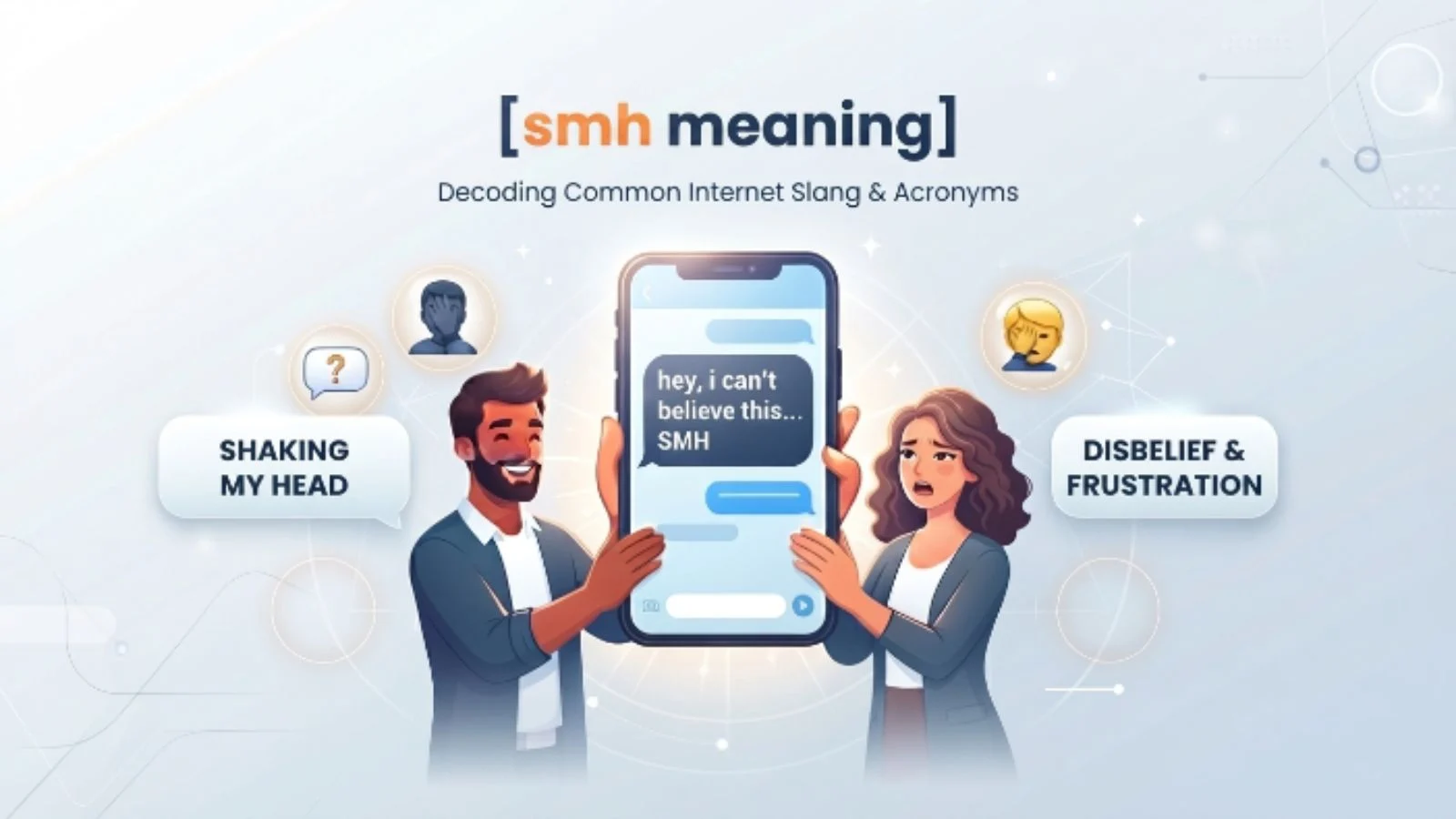
Have you ever received a text that made you shake your head in disbelief, frustration, or disappointment?
You may have wanted to say, “I cannot believe you just did that,” but typing the whole sentence felt unnecessary. That is where SMH comes in.
If you have seen SMH in texts, comments, TikTok captions, Instagram posts, Snapchat messages, or online chats and wondered what it means, you are not alone.
In this guide, you will learn the SMH meaning, where it comes from, how people use it, what emotions it can express, and when you should or should not use it.
What Does SMH Mean?
SMH means “shaking my head.”
It is an internet and texting abbreviation people use to show disbelief, disappointment, frustration, annoyance, or embarrassment about something.
For example:
“You forgot your keys again? SMH.”
This means:
“I cannot believe you forgot your keys again. I’m shaking my head.”
SMH is usually used informally. You will commonly see it in text messages, social media comments, online conversations, and casual chats.
SMH Meaning in Simple Words
In simple English, SMH means “I can’t believe this” or “I’m disappointed by what happened.”
The exact feeling depends on the situation.
Someone might use SMH because:
- They are annoyed.
- They cannot believe something happened.
- Someone made an obvious mistake.
- A friend did something silly.
- They disagree with someone’s behavior.
- Something is disappointing.
- A situation seems ridiculous.
For example:
“He left his phone at home again. SMH.”
Here, SMH expresses mild frustration or disbelief.
It does not necessarily mean the person is extremely angry. Often, it has a humorous or playful tone.
What Does SMH Stand For?
SMH stands for “shaking my head.”
The phrase comes from the physical action of shaking your head when you disagree with something, feel disappointed, or cannot believe what you are seeing.
Imagine your friend telling you:
“I studied for five minutes and thought I was ready for the exam.”
You might respond:
“SMH.”
Your response suggests that you cannot believe what your friend just said.
The abbreviation simply turns that familiar reaction into three letters.
Where Is SMH Used?
SMH is mostly used in casual digital communication.
You can find it across many online platforms and messaging services.
Common places include:
- Text messages
- TikTok
- Snapchat
- X
- Discord
- Online gaming chats
- YouTube comments
- Group chats
The meaning generally stays the same, although the tone can change depending on the conversation.
SMH in Text Messages
In texting, SMH is often used as a quick reaction.
For example:
Person 1: “I accidentally deleted the file.”
Person 2: “SMH, you should have backed it up.”
Here, SMH expresses frustration and mild disbelief.
SMH on Social Media
On social media, people often use SMH when reacting to a post, opinion, news story, or unusual situation.
For example:
“Someone actually believes the Earth is flat. SMH.”
In this example, the writer is expressing disbelief or disagreement.
SMH in Group Chats
Group chats can make SMH even more common because people often use short expressions to react quickly.
For example:
Friend 1: “I told Mom we were going out tonight.”
Friend 2: “Why would you do that?”
Friend 3: “SMH.”
The abbreviation can communicate a reaction without requiring a long explanation.
Why Do People Use SMH?
The biggest reason people use SMH is convenience.
Typing “I am shaking my head because I cannot believe what just happened” would be unnecessary in a casual conversation.
SMH communicates the basic reaction in just three letters.
People also use it because it can make a message feel more natural and conversational.
1. To Show Disbelief
Someone may use SMH when something seems unbelievable.
“She said she forgot her own birthday. SMH.”
The writer is surprised and does not quite know what to say.
2. To Express Disappointment
SMH can communicate disappointment without sounding overly serious.
“You promised you would clean your room. SMH.”
The person is disappointed by the other person’s behavior.
3. To React to a Silly Mistake
SMH is often used when someone makes an obvious mistake.
“I spent 20 minutes looking for my glasses. They were on my head. SMH.”
Here, the expression is humorous rather than angry.
4. To Show Annoyance
Someone may use SMH when another person repeatedly does something irritating.
“He is late for the third meeting this week. SMH.”
The writer is clearly annoyed.
5. To Make a Joke
SMH does not always indicate serious criticism.
Friends often use it jokingly.
“I ate the entire pizza by myself. SMH.”
The person is joking about their own behavior.
Real-Life Examples of SMH
Understanding examples is one of the easiest ways to understand how SMH works.
Example 1: Forgetting Something
“I left my wallet at home again. SMH.”
Meaning: The person is disappointed or amused with themselves for making the same mistake again.
Example 2: A Friend Makes a Silly Choice
“You bought another pair of shoes when you already have 20 pairs? SMH.”
Meaning: The speaker thinks the choice was unnecessary or ridiculous.
Example 3: Being Late
“He said he would be here at 8, and it’s already 9:30. SMH.”
Meaning: The person is frustrated and disappointed.
Example 4: Self-Directed Humor
“I searched everywhere for my phone while holding it. SMH.”
Meaning: The person is laughing at their own mistake.
Example 5: Online Reaction
“People still fall for these obvious scams. SMH.”
Meaning: The writer is expressing disbelief and disappointment.
Example 6: School or Work
“I finished the whole assignment and forgot to submit it. SMH.”
Meaning: The speaker is frustrated with their own mistake.
Example 7: Family Conversation
“My brother opened the fridge and asked what food we have. SMH.”
Meaning: The speaker finds the situation silly or amusing.
What Tone Does SMH Have?
The tone of SMH depends heavily on context.
It can be:
- Funny
- Playful
- Annoyed
- Disappointed
- Sarcastic
- Disapproving
- Frustrated
- Self-critical
This is important because the same abbreviation can communicate different emotions.
For example:
“I forgot my umbrella again. SMH.”
This is probably lighthearted.
But:
“The company ignored all the safety warnings. SMH.”
This sounds much more serious and critical.
SMH vs. Similar Texting Terms
SMH is related to several other internet expressions, but they are not exactly the same.
| Term | Meaning | Common Feeling |
|---|---|---|
| SMH | Shaking my head | Disbelief, disappointment, frustration |
| OMG | Oh my God | Surprise or shock |
| WTF | What the f*** | Strong surprise, confusion, or anger |
| LOL | Laughing out loud | Amusement |
| IDK | I don’t know | Uncertainty |
| SMDH | Shaking my damn head | Stronger frustration or disbelief |
| Facepalm | A reaction to something foolish | Embarrassment or disbelief |
SMH vs. SMDH
SMDH means “shaking my damn head.”
It is similar to SMH but usually adds stronger frustration or disbelief.
For example:
“You forgot your passport before an international flight? SMDH.”
The reaction is stronger than a simple SMH.
SMH vs. Facepalm
A facepalm usually describes the reaction of covering your face with your hand because something is foolish, embarrassing, or frustrating.
SMH is broader.
You can use SMH for disappointment, disbelief, annoyance, or humor without necessarily suggesting embarrassment.
SMH vs. OMG
OMG mainly communicates surprise or shock.
SMH usually communicates disbelief, disappointment, or frustration.
Compare:
“OMG, you won the competition!”
This shows excitement and surprise.
“You forgot to enter the competition? SMH.”
This shows disappointment or disbelief.
When Should You Use SMH?
SMH works best in casual conversations.
You can use it when talking to:
- Friends
- Family members
- Classmates
- Online friends
- Gaming friends
- Social media followers
It is especially useful when you want to give a short reaction.
For example:
“He spent all his money on snacks. SMH.”
The meaning is immediately understandable in an informal conversation.
When You Should Avoid SMH
Avoid using SMH in formal or professional communication unless you know the situation is extremely casual.
For example, you generally should not write:
“SMH, you missed the deadline.”
in a professional email to your manager or client.
Instead, use clear and professional language:
“I noticed that the deadline was missed. Could we discuss the next steps?”
The abbreviation can sound too casual, sarcastic, or disrespectful in formal settings.
Common Misunderstandings About SMH
Although SMH is simple, people sometimes misunderstand its tone.
Misunderstanding 1: SMH Always Means Anger
Not necessarily.
SMH can express mild amusement, disappointment, disbelief, or playful frustration.
“I put my shirt on backward. SMH.”
This is probably humorous rather than angry.
Misunderstanding 2: SMH Is Always Insulting
Not always.
Friends frequently use SMH affectionately or jokingly.
For example:
“You seriously watched that movie three times? SMH.”
Depending on the relationship, this could be playful teasing.
Misunderstanding 3: SMH Has Only One Emotional Meaning
The basic idea is “shaking my head,” but the emotion behind it depends on context.
It could mean:
- “I cannot believe this.”
- “That was a silly decision.”
- “I’m disappointed.”
- “That is ridiculous.”
- “You are making me laugh.”
- “Why would you do that?”
The surrounding conversation gives you the real meaning.
Misunderstanding 4: SMH Is Appropriate Everywhere
SMH is primarily informal internet slang.
It is best suited to casual communication rather than formal writing.
How to Reply When Someone Says SMH
Your response depends on why they used it.
If they are joking, you can joke back:
“I know, I know. My bad.”
If they are disappointed:
“You’re right. I should have checked first.”
If they are teasing you:
“Don’t judge me.”
If you are not sure what they mean, simply ask:
“What happened?”
The context usually makes their intention clear.
Can SMH Be Used at the Beginning or End of a Sentence?
Yes.
There is no strict rule about where SMH must appear.
At the Beginning
“SMH, you really forgot again?”
This makes SMH feel like an immediate reaction.
At the End
“You really forgot your keys again, SMH.”
This makes the abbreviation feel like a final reaction.
As a Standalone Response
“SMH.”
A single SMH can be enough when the situation is obvious.
For example:
Friend: “I accidentally sent the private message to the group chat.”
You: “SMH.”
The entire reaction is communicated with three letters.
Capitalized or Lowercase: SMH vs. smh
You may see both SMH and smh online.
They generally have the same meaning.
SMH can feel slightly stronger or more noticeable.
smh often feels more casual and relaxed.
For example:
“SMH, I can’t believe I did that.”
and
“smh I can’t believe I did that”
mean essentially the same thing.
The difference is mainly about writing style and emphasis.
Pro Tips for Using SMH Correctly
If you want to use SMH naturally, keep these tips in mind.
1. Consider the Relationship
SMH is more appropriate with people you know well.
A close friend may understand your playful tone, while a stranger could interpret it as rude.
2. Look at the Context
Do not assume every SMH means anger.
Look at the words before and after it to understand the emotion.
3. Use It Sparingly
If you use SMH in every message, it can lose its effect.
Use it when the situation genuinely calls for a reaction.
4. Be Careful With Serious Topics
SMH can sound dismissive when used during a serious conversation.
If someone is sharing a difficult personal experience, a more supportive response is usually better.
5. Avoid It in Formal Writing
Professional emails, academic assignments, business proposals, and official documents usually require standard language.
Use “I am disappointed,” “I am surprised,” or another clear phrase instead.
Frequently Asked Questions About SMH
What does SMH mean in texting?
SMH means “shaking my head.” It is used to express disbelief, disappointment, frustration, annoyance, or amusement about something someone said or did.
Is SMH rude?
SMH can be rude depending on the context. Among friends, it is often playful. In a serious or professional conversation, however, it may sound dismissive or judgmental.
What does SMH mean on social media?
On social media, SMH usually means “shaking my head.” People use it when reacting to something they find unbelievable, disappointing, foolish, annoying, or ridiculous.
What is the difference between SMH and SMDH?
SMH means “shaking my head,” while SMDH means “shaking my damn head.” SMDH generally expresses a stronger level of frustration, disbelief, or disappointment.
Final Thoughts
So, what does SMH mean? It means “shaking my head,” and it is one of the most common abbreviations used in casual online communication.
People use SMH when they cannot believe something, feel disappointed, notice a silly mistake, or simply want to react with mild frustration. Its exact emotion depends on the context and relationship between the people talking.
You will commonly see SMH in text messages, social media comments, group chats, gaming conversations, and other informal online spaces.
The key is to remember that SMH is about reaction. Someone may use it seriously, sarcastically, or playfully.
When you understand the context, the meaning is usually easy to recognize.