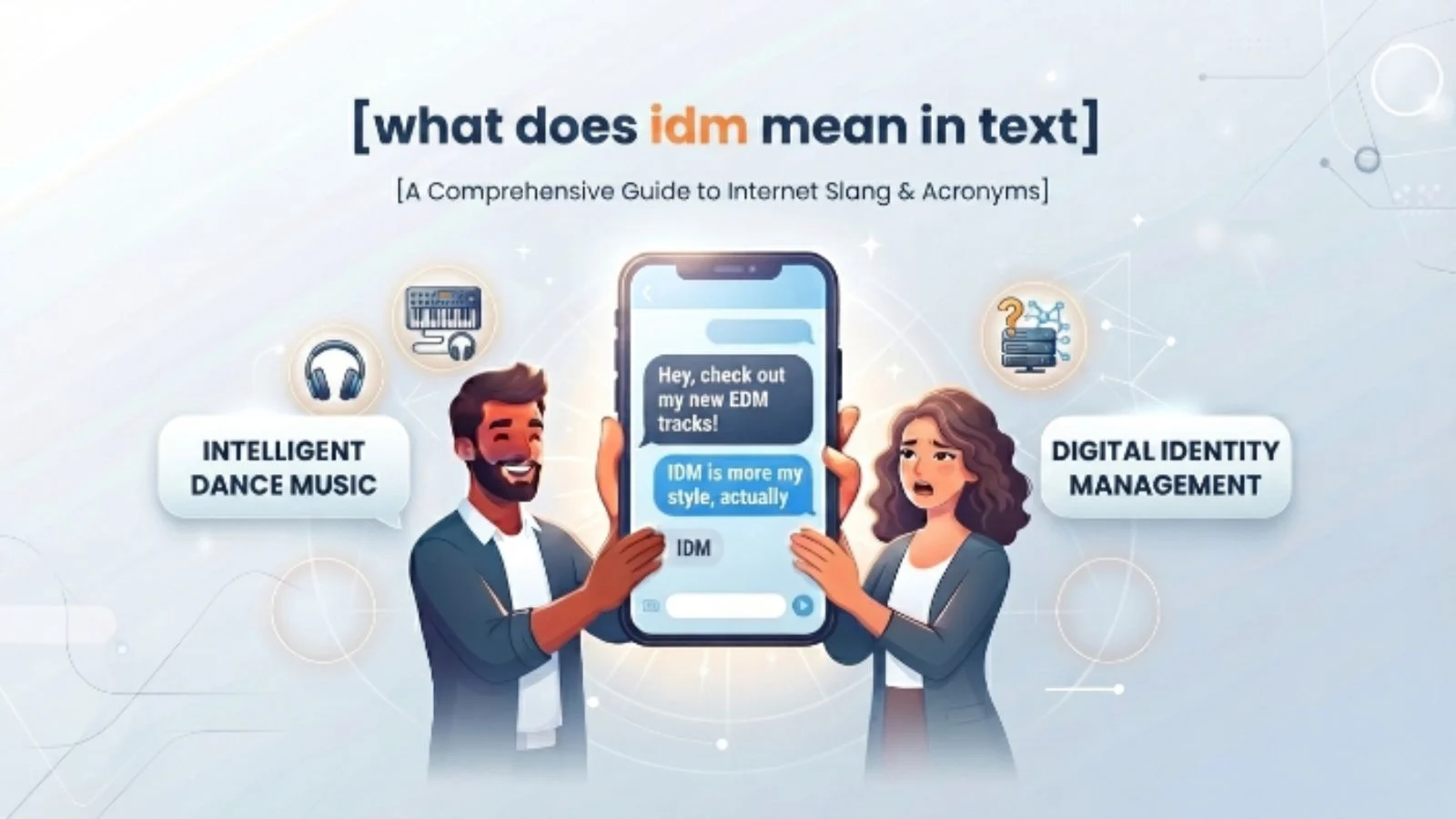
Have you ever received a text like “idm, you can choose” or “idm if you come later” and wondered what IDM actually means?
Texting slang can be confusing because the same three letters can mean different things depending on the conversation. Fortunately, IDM is usually easy to understand once you know the context.
In everyday texting, IDM most commonly means “I Don’t Mind.” People use it to show that they are okay with something, do not have a strong preference, or are happy to let someone else decide.
For example:
“Where should we eat?”
“idm, you pick.”
Here, “idm” means “I don’t mind”, meaning the person does not care which restaurant they choose.
But there is more to this abbreviation. Let’s look at what IDM means, how people use it, when you should use it, and how it differs from similar texting expressions.
What Does IDM Mean in Text?
IDM means “I Don’t Mind” in text messages and online conversations.
It is an informal abbreviation commonly used when someone wants to say that they are okay with something, have no preference, or do not object to a particular choice.
Simple definition
IDM = I Don’t Mind
It can communicate meanings such as:
- I’m okay with it.
- I don’t care which option you choose.
- Either choice is fine with me.
- It doesn’t bother me.
- You can decide.
- I have no problem with that.
For example:
“Do you mind if I call you later?”
“idm.”
The person is saying, “I don’t mind.” They are giving permission or showing that the situation does not bother them.
Because IDM is informal, it is most suitable for casual conversations rather than formal emails, business documents, or professional communication.
What Does “I Don’t Mind” Mean?
The phrase “I don’t mind” generally means that something is acceptable to you.
It does not necessarily mean that you strongly like the idea. Instead, it often means that you are comfortable with either choice or you have no objection.
Consider this conversation:
“Do you want tea or coffee?”
“IDM. You can choose.”
The person is not saying, “I love both.” They are simply saying that either option is fine.
This small difference is important because IDM can sometimes sound neutral rather than enthusiastic.
IDM can show flexibility
If someone says:
“What time should we meet?”
“IDM, whenever works for you.”
They are showing that they are flexible and allowing the other person to choose.
In this situation, IDM helps make the conversation shorter and more relaxed.
Where Is IDM Used?
You can see IDM in many informal digital conversations.
It may appear in:
- Text messages
- WhatsApp chats
- Instagram messages
- Facebook Messenger
- Snapchat
- Discord
- Online gaming chats
- Group chats
- Casual social media conversations
- Dating or friendship conversations
The abbreviation is especially useful when people are typing quickly and want to avoid writing the full phrase “I don’t mind.”
For example:
“Movie tonight?”
“idm.”
This is much shorter than:
“I don’t mind.”
The meaning remains essentially the same.
Why Do People Use IDM?
There are several reasons people use IDM instead of typing the complete phrase.
1. It saves time
Texting is often fast and informal. Short abbreviations make communication quicker.
“Which color should I get?”
“idm, both look good.”
Instead of typing a longer response, the person can simply use IDM.
2. It shows flexibility
IDM can tell someone that you are comfortable with their decision.
“Should we go Friday or Saturday?”
“IDM, whichever works for you.”
This means the person does not have a strong preference.
3. It keeps the conversation casual
Abbreviations such as IDM fit naturally into friendly conversations.
They can make a message feel less formal and more like everyday speech.
4. It avoids unnecessary disagreement
Sometimes people use IDM when they do not want to argue over a small decision.
For example:
“Pizza or burgers?”
“IDM, you decide.”
The speaker is basically saying, “I’m fine with either one.”
Real-Life Examples of IDM in Text
Understanding IDM becomes much easier when you see it in actual conversations.
Example 1: Choosing a restaurant
Friend: “Do you want to eat at the new pizza place?”
You: “idm, sounds good.”
Meaning: You are okay with going there.
Example 2: Making plans
Friend: “Should we meet at 6 or 7?”
You: “IDM, 7 works.”
Meaning: You do not have a strong preference, and 7 is acceptable.
Example 3: Choosing a movie
Friend: “Comedy or horror?”
You: “idm. You pick.”
Meaning: You are happy to let your friend choose.
Example 4: Asking for permission
Friend: “Do you mind if I bring my brother?”
You: “IDM.”
Meaning: You do not have a problem with them bringing their brother.
Example 5: Group chat
Friend: “Should we play tonight or tomorrow?”
You: “IDM, either works.”
Meaning: Both choices are fine with you.
Example 6: Casual conversation
Person A: “Can I call you after dinner?”
Person B: “idm.”
Meaning: The person is okay with receiving the call later.
IDM vs Similar Texting Terms
IDM can look similar to several other expressions, but they do not always carry exactly the same meaning.
| Term | Meaning | Typical Use |
|---|---|---|
| IDM | I Don’t Mind | Showing no objection or preference |
| IDC | I Don’t Care | Showing a lack of concern or interest |
| IDK | I Don’t Know | Saying you do not know something |
| NVM | Never Mind | Telling someone to disregard something |
| IKR | I Know, Right? | Agreeing strongly with someone |
| Whatever | Any option is acceptable / dismissive | Depends heavily on tone |
| Up to you | You decide | Giving another person the choice |
IDM vs IDC
This is one of the most important differences.
IDM usually sounds neutral or agreeable.
“Tea or coffee?”
“IDM.”
This means either option is fine.
IDC, or “I Don’t Care,” can sometimes sound more dismissive.
“Tea or coffee?”
“IDC.”
Depending on the situation, IDC may sound like the person is uninterested or annoyed.
So if you want to sound friendly and flexible, IDM is often the safer choice.
IDM vs IDK
These abbreviations are completely different.
IDM = I Don’t Mind
IDK = I Don’t Know
For example:
“Do you want to go?”
“IDM.”
This means the person is okay with going.
But:
“What time does the store close?”
“IDK.”
This means the person does not know the answer.
When Should You Use IDM?
You can use IDM when you are chatting casually and want to show that you have no objection or strong preference.
It works well when:
- Someone asks you to choose between two options.
- Someone asks whether something bothers you.
- You want another person to make the decision.
- You are comfortable with a suggested plan.
- You want to show that either option is acceptable.
For example:
“Do you want to sit inside or outside?”
“IDM, wherever you want.”
That is a natural use of the abbreviation.
When Should You Avoid Using IDM?
Although IDM is common in casual texting, it is not appropriate for every situation.
Avoid using it in:
- Formal business emails
- Job applications
- Academic assignments
- Official letters
- Professional reports
- Formal customer-service communication
Instead of writing:
“IDM if you change the meeting time.”
A professional version would be:
“I don’t mind if you need to change the meeting time.”
The full phrase is clearer and more professional.
Does IDM Always Mean “I Don’t Mind”?
Usually, yes, when discussing texting slang.
However, abbreviations can sometimes have different meanings in different industries, communities, or contexts. For example, IDM may be used as an acronym for something unrelated to texting.
That is why context matters.
If you see IDM in a casual conversation about plans, food, time, preferences, or permission, “I Don’t Mind” is usually the intended meaning.
If you see IDM in a technical, academic, medical, business, or specialized discussion, it may have another meaning.
Common Misunderstandings About IDM
Misunderstanding 1: IDM means “I love it”
Not necessarily.
If someone says:
“Do you want pizza?”
“IDM.”
They are not necessarily saying that pizza is their favorite food.
They are simply saying that they are fine with pizza.
Misunderstanding 2: IDM means “I don’t care”
Not exactly.
IDM and IDC can sometimes produce similar results in a conversation, but their tone can be different.
IDM generally communicates acceptance.
IDC can sometimes communicate indifference or lack of interest.
Misunderstanding 3: IDM is always rude
No. IDM is not inherently rude.
However, a very short reply can sometimes feel cold depending on the conversation.
For example:
“Would you like to come to my birthday party?”
“idm.”
Although technically understandable, it might sound less enthusiastic than:
“Sure, I don’t mind!”
Tone depends on the surrounding conversation.
How to Respond When Someone Says IDM
Your response depends on what you asked.
If you gave someone two choices and they replied “IDM,” you can simply make the decision yourself.
For example:
You: “Friday or Saturday?”
Them: “IDM.”
You: “Okay, let’s do Friday.”
If you asked whether something was acceptable:
You: “Do you mind if I bring another friend?”
Them: “IDM.”
You: “Thanks!”
In most situations, IDM means you can continue without worrying that the person objects.
Pro Tips for Using IDM Naturally
Use lowercase in casual texting
You may see:
- idm
- IDM
- Idm
All can communicate the same meaning.
In casual texting, “idm” often looks the most natural.
Consider the tone
A one-word reply can sometimes sound blunt.
Instead of:
“idm.”
You can write:
“idm, whatever works for you.”
This makes your meaning warmer and clearer.
Do not use IDM when you actually have a preference
Suppose your friend asks:
“Do you want to go at 5 or 8?”
If you strongly prefer 5, saying “idm” may create confusion.
It is better to say:
“5 would be better for me.”
IDM works best when you genuinely do not have a strong preference.
Remember that context matters
If the conversation is formal, spell out “I don’t mind.”
If the conversation is casual, IDM is perfectly understandable in most situations.
What Does IDM Mean From a Girl or Guy?
The meaning of IDM does not automatically change based on who sends it.
If a girl texts:
“idm, you choose.”
It usually means “I don’t mind; you choose.”
If a guy texts:
“idm if you come later.”
It usually means “I don’t mind if you come later.”
The important thing is the context, not the sender’s gender.
However, tone can still depend on the relationship. A close friend may use IDM casually, while someone you barely know might use it simply to remain neutral.
Is IDM a Positive or Negative Response?
IDM is usually neutral to mildly positive.
It generally means the person is not opposed to something.
For example:
“Do you want to watch this movie?”
“IDM.”
This means the person is willing to watch it.
But IDM does not necessarily express excitement.
If someone says:
“Absolutely! I’d love to!”
That shows much stronger enthusiasm than:
“IDM.”
So think of IDM as acceptance rather than excitement.
Frequently Asked Questions About IDM
What does IDM mean in texting?
IDM means “I Don’t Mind.” It is used in casual text messages to show that someone is okay with something, has no objection, or does not have a strong preference.
What does IDM mean on social media?
On social media and in casual chats, IDM usually means “I Don’t Mind.” It can be used when someone wants to say that either choice is acceptable or that something does not bother them.
Is IDM the same as IDC?
No. IDM means “I Don’t Mind,” while IDC means “I Don’t Care.” IDM usually sounds more accepting, while IDC can sometimes sound more indifferent or dismissive.
Is IDM formal or informal?
IDM is informal. It is suitable for texting, social media, gaming chats, and conversations with friends. In professional or formal writing, it is better to write “I don’t mind” in full.
Final Thoughts
So, what does IDM mean in text? In most casual conversations, IDM means “I Don’t Mind.”
People use it when they are okay with something, have no strong preference, or want someone else to make a choice.
You might see it when friends are deciding where to eat, when to meet, what movie to watch, or whether a particular plan is acceptable.
The most important thing to remember is that IDM usually expresses acceptance, not strong excitement. It is also different from IDC, which can sound more indifferent.
If you are chatting casually with friends, “idm” is a quick and natural way to say “I’m fine with that.” Just remember to consider the context and use the full phrase when you are communicating in a formal or professional setting.