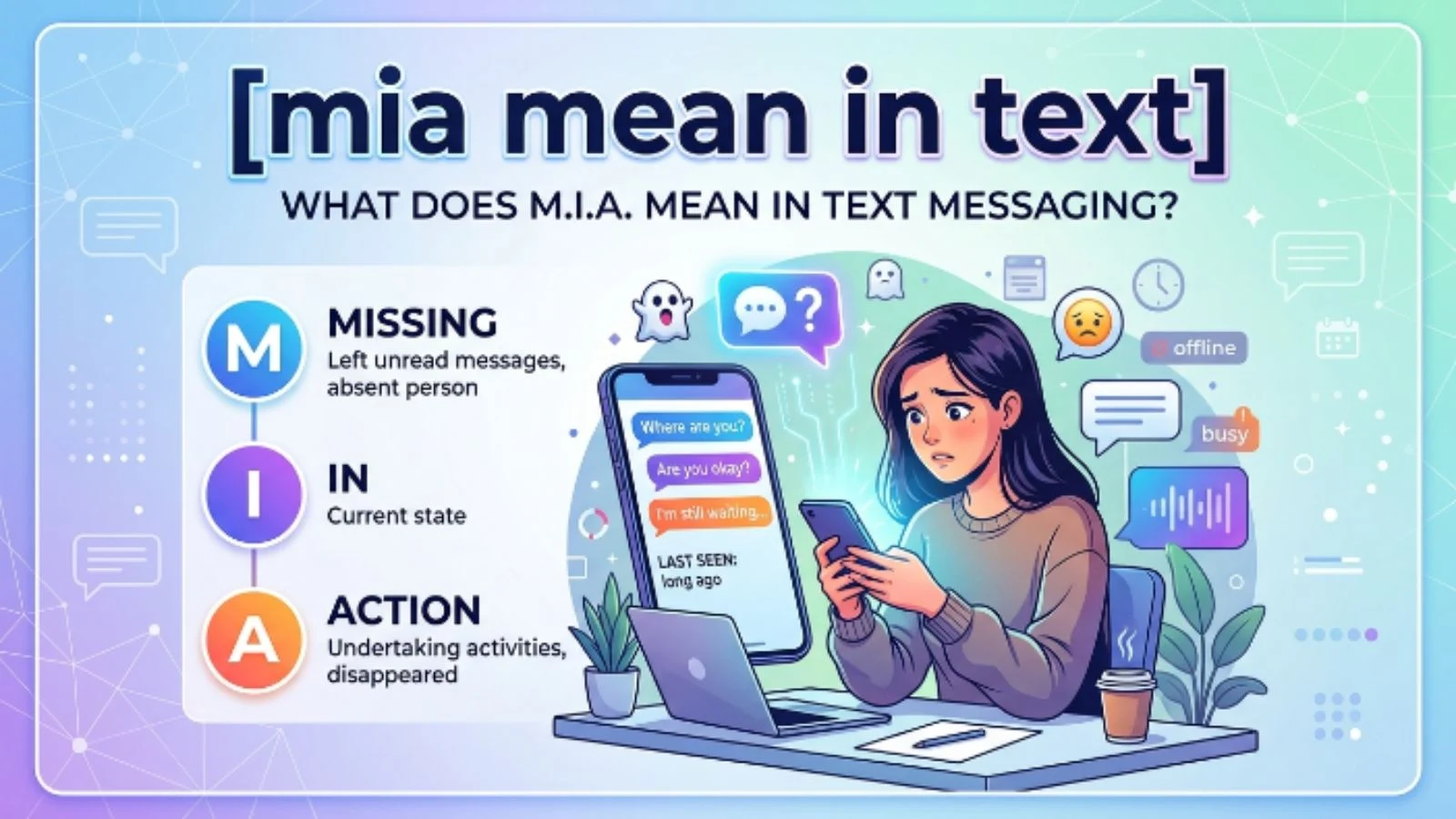
Have you ever texted a friend and received no answer for hours or days? You might say that your friend has gone MIA.
Text abbreviations can be confusing. People use short terms to save time when typing on their phones. If you do not know what these terms mean, you can easily lose track of the conversation.
This guide will explain everything you need to know about MIA. You will learn its definition, where it comes from, how people use it in 2026, and how to avoid common mistakes.
The Short Answer: What Does MIA Mean?
In text messages and online chats, MIA stands for Missing in Action.
When someone uses this term in a text, it means that a person is suddenly unavailable, hard to reach, or nowhere to be found. It usually means the person stopped replying to messages or skipped an event without telling anyone.
Here is a simple breakdown of the words:
- Missing: You cannot find the person.
- In Action: While they were supposed to be active, working, or hanging out.
If your friend promises to meet you at the park but does not show up and does not answer their phone, your friend is MIA.
The Origin and History of MIA
Long before people had mobile phones or the internet, MIA was an official military term.
Military Roots
The United States military started using the acronym MIA during the 20th century, notably during World War I and World War II. The military used it to describe a soldier who did not return from a battle, but no one could confirm if the soldier was captured or dead. It simply meant the soldier was lost during the action.
Shift to Daily Conversation
Over many decades, the term left the military and entered daily speech. People loved the phrase because it was a dramatic and quick way to describe anyone who vanished. By the time texting became popular in the early 2000s, MIA was already a common slang term for a person who was late or missing.
Today, in 2026, the military still uses the term for serious situations. However, in text messages, it is just a casual way to talk about a friend who is bad at replying to messages.
MIA Meaning Comparison Table
To help you understand how the meaning changes based on where you see it, look at this simple comparison table.
| Context | What MIA Stands For | What It Actually Means | Tone of Voice |
| Text Messaging | Missing in Action | A friend is not answering texts or missed a meeting. | Casual and informal |
| Work / Office | Missing in Action | A coworker missed a meeting or is not online. | Semi-formal or annoyed |
| Military | Missing in Action | A soldier is lost during a combat mission. | Very serious and formal |
Real-Life Examples and Short Dialogues
The best way to learn language terms is by seeing them in real conversations. Here are three different dialogues that show how people use MIA in daily texts.
Example 1: Chatting About a Missing Friend
In this chat, two friends are wondering why their other friend is not answering them.
Sam: Hey, have you heard from Tom today?
Ben: No, he went MIA after lunch. I texted him three times.
- Explanation: Ben uses MIA to show that Tom stopped replying to text messages suddenly.
Example 2: Checking on a Coworker
In this chat, two office workers are waiting for a team member to join an online work chat.
Sara: Is Mark coming to the online meeting?
Amy: I am not sure. He is completely MIA on the company app today.
- Explanation: Amy uses MIA to explain that Mark is not logged in and cannot be found online for work.
Example 3: Planning a Weekend Party
In this chat, friends are trying to plan a dinner party but one person is not replying.
Leo: Did Jess say if she is coming to dinner tonight?
Max: She has been MIA all week. We should just order food without her.
- Explanation: Max uses MIA to describe how Jess has ignored all group messages for several days.
Modern and Relatable Examples for 2026
The way we communicate changes fast. In 2026, people use many different apps like WhatsApp, Discord, and Slack. Here are some modern ways you will see MIA used today.
- Ghosting on Apps: A person might say, “My match on the dating app went MIA right before our date.” This means the person stopped texting out of nowhere.
- Gaming Group Chats: If a player leaves a video game match without saying goodbye, the team might text, “Our main healer is MIA, we need to pause the game.”
- Social Media Breaks: Someone might post on their profile, “Going MIA for a week to enjoy nature.” This means they are turning off their phone.
Personality Traits: Who Goes MIA Most Often?
Not everyone uses technology the same way. Certain types of people are more likely to go MIA than others. Here are a few common personality traits of people who vanish from text chats.
- The Busy Worker: This person gets overwhelmed with tasks. They do not hate you; they just forget to check their phone because they are working hard.
- The Introvert: This person needs alone time to recharge their energy. They go MIA because social interactions make them tired.
- The Forgetful Friend: This person reads your message, replies to it in their head, but forgets to actually type and send the response.
- The Bad Communicator: This person simply dislikes typing. They prefer talking face-to-face and rarely look at text alerts.
Common Mistakes and Misconceptions
Because MIA is an abbreviation, beginners often make mistakes when using it. Here are the most common errors to avoid.
1. Thinking MIA Means “Dead”
In modern text messages, MIA is never literal. It is a lighthearted exaggeration. Do not worry if someone says a friend is MIA. It just means they are busy or sleeping, not in danger.
2. Spelling It Wrong
Some people write the term as “mia” or “Mia” like the female name. When you mean the abbreviation, it is best to capitalize all three letters: MIA. This makes it clear that you are using an acronym.
3. Confusing MIA with AWOL
Another military term is AWOL, which means Absent Without Leave. While MIA means someone is lost and you do not know why, AWOL implies the person ran away on purpose to avoid duty. In casual texting, MIA is much softer and friendlier than AWOL.
Grammar and Usage: How to Put MIA in a Sentence
You can use MIA as an adjective in your sentences. It usually comes after verbs like “is,” “was,” “are,” or “went.”
Here are the correct patterns to use:
- Subject + is/are/was + MIA
- Example: My sister is MIA tonight.
- Subject + went + MIA
- Example: The delivery driver went MIA with my food.
Summary of Related Text Abbreviations
To build your vocabulary further, here is a list of other short terms that people use when talking about communication and presence.
- BRB: Be Right Back. Use this when you need to leave the chat for just a few minutes.
- AFK: Away From Keyboard. Gamers use this when they step away from their computers.
- TIA: Thanks In Advance. Use this when you ask for help and want to thank the person early.
- OOTO: Out Of The Office. Work teams use this when they are on vacation.
Frequently Asked Questions
Is MIA rude to use in a text message?
No, it is generally not rude. It is a casual expression used among friends. However, you should avoid using it in formal emails to your boss, as it might sound too unprofessional.
What is the difference between ghosting and going MIA?
Ghosting usually means someone cuts off communication permanently, often ending a relationship. Going MIA is temporary. A friend who is MIA will usually text you back a few days later with an apology.
Can MIA be used for objects?
Yes, people often use MIA for lost items. For example, you can say, “My car keys are MIA this morning.” This means you cannot find your keys anywhere.
Do older people understand what MIA means?
Yes, older people often know this term very well. Because it started as a military term in the 1900s, older generations are familiar with it, though they may use it in a slightly more serious way.
How should I reply when someone tells me they went MIA?
You can reply with a friendly message. Try saying, “No worries, I hope you are doing well!” or “Welcome back! What kept you so busy?”
Is MIA used in speech or just in text?
People use it in both speech and text. When speaking out loud, you pronounce each letter individually as M-I-A.
Conclusion
Understanding modern slang like MIA helps you stay connected with friends, family, and coworkers. It is a simple way to say someone is temporarily unavailable or hard to find. Now that you know the meaning, origin, and proper context of this acronym, you can use it confidently in your daily chats.
If you want to master English text slang and improve your communication skills, take a moment to practice. Try using MIA in a sentence during your next casual text conversation with a close friend to see how natural it feels.